An Unexpected Adventure

My pocketbook was stolen on Thursday morning.

I was at fault; the owner provides the first layer of security and I admit I left it on the seat in the pediatrician’s waiting room unsupervised. That was a dumb thing to do in a town with a high number of desperate heroin addicts.

So. My story begins on Wednesday, as I prepared for the monthly dinner and discussion of our fellowship group we call TWIG. I forget exactly what all the letters stand for, but I do know we made a mistake when we coined it the “Third Wednesday Something Group.” We meet on fourth Wednesdays. We can’t call it FWIG What is a fwig? At least we can say we are twigs from the vine. No one has come up with a better name so we keep it and laugh at ourselves.

As we took turns around the table telling the group what we were dealing with these days, I was touched and encouraged by the tenacious faith of two fellows in particular. I used to be like that; but I “have sinned and grown old”* and those days seem long ago. I have faith, don’t get me wrong, but it is like having title to a property I do not visit.

So, in my Thursday morning devotions, I was open to hear from God when I read in Jeremiah 17:7 “Blessed is the man who trusts in the LORD and whose trust is the LORD.” It goes on with the metaphor of a tree planted by a stream so that even in times of drought it is watered, green, and fruitful. So I knew that I would take every opportunity to place my trust in the Lord that day, not putting my trust in my wits or any other ‘savior’.

So a few hours later when Abe and I came back to pediatrics from the x-ray department and realized my pocketbook was gone, I didn’t have a fit. As a parent I know the experience of taking my child into situations he finds uncomfortable, and asking him to trust me. It is like taking a toddler in a sled down a snowy slope for the first time. “It is going to be all right!” I am that child. I will not whimper. This is small stuff to my heavenly Father.

The police came for a report. The building manager came and we pored over the video stills. My pocketbook was on my shoulder when I got off the elevator; it was missing when I entered it again to get that x-ray. She looked for anyone leaving the building with it, but it could easily have gone out in a baby bag.

My car keys were in the bag. Actually, the keys for two cars were stolen, because I had the Honda set in there too. And I was astonished to learn when I went to the dealer to get a key cut that the car needs to be there in order for them to program the key to the car. And that meant two tows: the Dodge one mile to the dealer in Springfield, but the Honda 40 miles from my house to Keene.

Did you know these keys cost about $200 to replace? Fortunately, for much less you can get a no frills version without the clicker. No more opening the doors from afar to astonish and delight the uninitiated.

So, I spent the rest of Thursday setting this up and contacting my bank and my credit card companies. Did you know Google is tracing your travels by watching where your phone goes? StraightTalk wouldn’t locate my phone, but Google did. My son John saw that it never left the office, and was turned off or tossed in the river shortly after it was taken.

So, Friday morning I met the tow truck, driven by a wise old man who looked like he could have been captain of a lobster boat. He left me at Kelley Sales and Service and went off to get the Honda. After a while the service manager came to the waiting room and told me the Dodge had a dead electronic something something something and wouldn’t talk to the key. I got a ride home with a neat salesman, the old fashioned kind that really wants to serve (I would buy a car from him), and came upon the tow truck finishing up the challenge of getting my Honda caravan onto his huge flatbed in a not-so-huge space. Good thing my garden was frozen.

Alone at home again, I called Honda to let them know a car was being towed to them. (Meanwhile, my boys are working through their lines of Caesar translation without me.) That’s when I learned they would not cut a key until I showed up in person to prove my identity. I had no car and I had no driver’s license. Actually, I had two cars: a 1951 International that Grandpa built and just might make it all the way to Keene and back without a breakdown (but is registered, inspected, and insured), or the 2000 Dodge caravan that runs well but is none of those things.

I called a friend who is an artist and works at home. She volunteered immediately and needed to go to Keene anyway.I brought my birth certificate and marriage license which I still had in the house after renewing my Vermont driver’s license a couple of months ago. They fixed the car and got me on the road again. I lingered in the Big Town to shop for a pocketbook and wallet.

Meanwhile, the bad guys attempted to get $6300 from my checking account. Twice. The account is flagged so nothing is going to happen without scrutiny. I just happened to know the last two check numbers I wrote and their amounts so we put a block on the checks in my wallet. No activity occurred on my credit cards. They didn’t come back and take the Dodge, which they could have done by driving slowly through the parking lot and clicking the door-unlock button. It could have been a lot worse.

Since my phone, for my convenience, is not locked with a password, the thief had access to my gmail and other apps. A few hours after the purse was taken, I left $40 with the receptionist of the orthodontist, and sent an email to my phone with “Please return my pocketbook” in the subject and saying they could have it if they returned it and the phone, no questions asked. It could have worked! But we now think they got rid of the phone shortly after they took it.

Lots of this troubles me. Someone has intimate details of our family life and finances. They know where we live. The cost of this comes at a bad time, when I had already gone over budget for February. (That was for our anniversary getaway and I don’t regret a thing!) It took two days out of a particularly busy week: FAFSAs are due March 1 for scholarships eligibility and I still needed to do taxes for some of the kids. And I have several lessons to prepare for subbing.

Every time I thought about these things, I “preached to my soul”, remembering that I can trust Him. This is small thing for God! He is willing and able to walk me through this.

“Though he slay me, yet will I trust Him,” says Job.

He is worthy.
*G.K.Chesterton: quotation from Orthodoxy
Posted in Stories of Home | 3 Comments

Death Ice: The Sequel

This is written by Nicole Bartner, own of the Hartland Diner, and judge for Classical Conversations’ Mock Trial last year and in 2016. I needed the laugh.

There is so little explanation for really anything that happens at The Diner. I mean, I’ve got data. Do I have data! I can look back at any day that we’ve been open. I can break sales down by month…

Source: Death Ice: The Sequel

Posted in Stories of Home | Leave a comment

National School Choice Week 2016

Just as we begin to think about next year’s options, National School Choice Week gives schools an opportunity to showcase who they are and what they offer. Upper Valley Classical Community will have an Open House celebrating classical education and home school on Thursday night, January 28, 7-8pm.

School Choice Week Kickoff

You are invited to an open house about home school classical education on Thursday January 28, 7-8 pm, Valley Bible Church, White River Junction.

We are a group of families who for various reasons chose to home school our children. Most of us do not have something against the public system but instead want to offer our students an education they cannot receive in a public school. One of those is a classical curriculum, a true liberal arts education that teaches students how to learn for the rest of their lives. My children and I have been working with the Classical Conversations program for six years and I have had stunning results. It has even given me a second (and better) education.

About twenty families meet once a week in the classrooms of Valley Bible Church. Three levels meet there, one for each of the Trivium: Grammar, Dialectic, and Rhetoric, which are the first three of the Seven Liberal Arts. So this is what it looks like: kids K-6 study the “grammar” of the major disciples, gathering facts. They learn, for example, math facts, major rivers and mountains, the parts of speech, 100 common prepositions, science terms, and a timeline of nearly 200 events. They learn them by song and chant, and enjoy it. They also make presentations, do science labs, explore art, and sing. That is from 9 am to noon once a week. This is the GRAMMAR stage. At home they review these and do reading, math, history.

Grades 4-6 add to that a deep study of English grammar and classical writing from 1-3 pm on the day we meet. These students are entering the DIALECTIC stage, where they learn how the facts are connected. If the facts are pegs nailed into a wall, the dialectic stage is the time when connections are linked from peg to peg in understanding. Grades 7 and 8, therefore, study logic, history of science, the classical essay, beginner’s debate, geography, science fair and much more. This is the time when our children naturally ask, “Why should I do this?” “How does this work?” and notice when our argument is weak. We teach them logic so they can make better arguments and recognize why an argument is poor.

Junior high and senior high students meet in six one-hour seminar to discuss their papers and the books they were assigned to read this week, make presentations, learn new Latin or Math concepts, do science labs, etc. Junior High students in the DIALECTIC stage begin to dialogue. High schools students are ready for the art of RHETORIC, in which they are trained how to find something to say and to communicate wisely and winsomely.

All of this is to say, we have something pretty special to offer families looking for ways to educate their children. We would love for you to see what we are doing. The event will only take an hour, during which the students will participate in short mock classes. I’ll also invite parents to give a short “elevator speech” to explain why they home school.


See you there!

Posted in Stories of Home | Leave a comment

The Logic of “Rain Causes Puddles”

Doubt it if you will, but Vermonters who drive I-91 will be happy, even eager, to tell you they saw the sign. It was broadcast in flashing safety-yellow from the movable roadside signs usually engaged in warnings such as, “Road narrows ahead/Move right” or “Icy conditions/Slow down”. For weeks last fall we were warned, “Rain causes puddles”. That’s all. Just, in all caps, “RAIN CAUSES PUDDLES”.

At some point it occurred to me that this constitutes an enthymeme of one statement. An enthymeme is a syllogism with one or two unstated truth claims; a syllogism is a three statement argument drawing a conclusion about a term by relating it to two other terms.

An example of a syllogism is:

Bushes grown in Pennsylvania will survive in Connecticut’s climate.
All these bushes were grown in Pennsylvania.
Therefore, these bushes will survive in Connecticut’s climate.

An enthymeme is a syllogism that doesn’t have everything spelled out; something is assumed by the speaker. Let’s say I live in Connecticut and am standing in my local tree nursery. I want to be sure the plants I buy will survive in the Connecticut climate. I know he doesn’t grow the bushes here; they are imported from wholesale nurseries elsewhere. The conversations with the owner might go like this:

“Will these survive winter in Connecticut?”

“Anything grown in Pennsylvania will survive in Connecticut. These are Pennsylvania-grown.” (The conclusion is assumed: Yes, these will grow in Connecticut.)

In ordinary communication it might be any of the statements which is assumed. The owner might say, “All these bushes were grown in Pennsylvania, so they will grow in Connecticut,” which assumes I know the climate of Pennsylvania is similar to Connecticut.

Or, if a sign by the plants makes it obvious they are from a Pennsylvania nursery, the owner might assure me by stating, “Anything grown in Pennsylvania will grow in Connecticut, so these will grow here.”

In each of these cases, two statements were stated, and one was assumed. But because we have such a tremendous amount of knowledge, we often get by with one. That nursery man might assure me of the conclusion, These plants will grow in Connecticut, with one statement only: “These were grown in Pennsylvania.” My mind supplies, “Oh, Pennsylvania has similar climate, so they will be fine in Connecticut.”

This is how we think all the time. You make tens of enthymemes a day, I am sure. “I’m running out of time so I’ll drop this errand.” (Assumed: it takes time to do the extra errand.)  “That meeting is for salesclerks only so I don’t have to go.” (I’m not a salesclerk.) “I’d better review Latin because tomorrow’s Tuesday.” (We have a quiz on Tuesdays.)

So, back to “Rain causes puddles”. It is an enthymeme of one statement, a syllogism with two assumed statements that all drivers should know.


Rain causes puddles.
Puddles cause hydroplaning.
Therefore, rain causes hydroplaning.

The purpose of this heady piece of reasoning? We are being reminded to adjust our driving accordingly.

To the good-humored traffic controller who programmed that sign, a subtle wit who respects the intelligence of the drivers of this interstate, I wave my windshield wiper in salute.

Posted in Stories of Home | Leave a comment

#TBT Gift Wrapped

We all have them, those memories that make us squirm and cringe.  Whether excruciatingly embarrassing or justly condemning, we have a permanent record of some really stupid moves. Like the time I swore a blue-streak at a pretty decent guy in high school. And the time I was asked in front of thirty people to give the pith of the opening sentence of the Declaration of Independence, and I went on and on instead of saying merely: ‘Common courtesy demands we state why we are breaking away.’ (That may not seem like a big deal, but it was a blow to my pride.)

I was cutting up onions one evening just before Christmas, weeping as I do on those occasions, and working up a good reason for tears by going over the latest crop of slimy memories.  Always looking for a reason to justify the extravagance and gift-giving that marks this holiday in my home, I made a fabulous connection.

Those experiences are gifts from God. Under the sovereignty of God each one of those experiences was foreordained, even crafted, for my benefit.  He makes no waste; even my sins and gaucheries work to sanctify me, to answer my heart’s desire to have more of the character of His Son. Each indiscretion is an answer to prayer for wisdom. Each one modified my behavior at least a little; I don’t repeat my ‘mistakes’ because the memory of the first burns so much.  And certainly the remembrance of my own failings gives me compassion for those whom I witness in theirs.

I will never see the gifts under the Christmas tree in the same way.

Posted in Stories of Home | 1 Comment

The Practical Education; Another Response to “Don’t Stay in School”

I admit the first time I watched the video “Don’t Stay in School” I felt incredibly irritated. David Brown recites in an edgy rap the kinds of things he had to learn in school instead of useful things he thought would have prepared him for life beyond school. He hoped to begin a conversation about education reform and it appears he has succeeded! Chances are your children have seen it and have an opinion about it. Watch it here: Don’t Stay in School Video (3 minutes). There is some objectionable language.

To recap: he says his education covered dissection of frogs, the quadratic equation, isotopes, mitochondria, abstract and mental math, cursive, hues of light, Old American West, and the wives of Henry VIII ad nauseum.

He says it did not prepare him for getting a job; nor was he taught about personal finances, economics, the English political system, English law, his human rights, first aid, mental health, current events, or how to raise a child.

Did you notice how his medium amplifies his message? He uses a provocative title. He uses pieces of subjects to represent the whole (for example, isotopes to represent Chemistry, and the solar system for Astronomy), an effective use of the rhetorical device synecdoche. He appears to use false dichotomy (either the quadratic equation or first aid) but I suggest this too is used for effect. David Brown actually did very well in school, went on to college, and launched a successful career. He is not simply whining about missing out. His anger is fueled by the ways in which his education was inadequate. Once I understood this, I could calm down and listen to his argument. After all, we share a similar frustration; I have not entrusted my children’s education to the public school.

His message is that no student should be forced to spend time on lessons that few will ever need, and that in their place life skills should be offered. Since I teach my children many lessons that have no immediate use for adult life, this pinched my soul and made me wince. But after thinking about this for days, I know what I would tell Mr. Brown if I had the chance. I suggest the two real problems are that schools cause students to lose their natural curiosity and that schools no longer equip students to think as free people.

First, every child begins with curiosity, but by eleven years old or so most have lost it. I watched it happen to my music students in elementary school. Fifth graders were still asking questions, but by sixth grade many had grown indifferent. Somehow learning turns into a chore. The best classrooms are the ones where teachers are able to stir up the students to wonder, “Why?”, “How?”, and “What if?” Those teachers are able to inspire every student, not just those who will eventually work in that field. Why is curiosity smothered in so many schools? It is natural to want to understand the physical and metaphysical world. Rather than remove the topics that feel like a waste of time to students who no longer care to learn them, nourish the love of learning that is inherent in every child.

For every child needs a foundation upon which to build his future. Every young woman needs an education that is broad enough to allow her to find her way through the complexities of adulthood. The young man who can derive the quadratic equation on his own will have the confidence to learn how to work with mortgage rates later. The young woman who studies Shakespeare has an early encounter with the complexity of the human psyche, which opens her mind and heart to the diversity of people she will meet. It is not necessary to teach every single thing a child needs to know for life; no school could be in session long enough to meet every practical need! We want graduates who are life-long learners, willing and able to continue to find answers to the challenges of life for another 60 years.

And this brings me to the second part of my response: What is education for, anyway? I believe it is to develop the whole soul— mind, heart, and will— so no area of study will be off limits to the graduate. Ultimately, we educate the next generation with the accumulated wisdom of the ages in order to prepare it for the challenges of their world. Society’s need has always been the same: for good governance, for a strong moral fabric, for protection for the weak, for comfort for the suffering. Only the details differ. Ideally we launch our young men and women, not weighed down with backpacks stuffed full of unconnected facts, but walking confidently, equipped with a strong mind that does not fear to tackle new situations. Let school teach them to persevere through hard tasks, go beyond their mental comfort zone, and ponder the consequences of ideas. The goal of education is to train lifelong self-teachers of good character who will provide for their families and serve where there is need.

See, this is one of the things that bothers me about the video. It comes across as saying, “The syllabus needs a different stack of facts,” which is not enough of a change, in my opinion. Education is still falling woefully short of its purpose if it does not rediscover the liberal arts, the arts that make men free. It is the funniest thing: David Brown exhibits a self-teaching mind, able and willing to research and press for solutions, but does not see that, to some degree, his education gave him this. Does he know how to get this result? As he studies education systems he will likely become aware of the vast conversation that has already been taking place for thousands of years about educating the young. He does not need to start from scratch. (If he does, anything he and his peers create will likely be dated and inadequate twenty years from now.) As Dorothy Sayers says in “The Lost Tools of Learning” in 1947, we need to rediscover the education that made mature thinkers who were still in their teens. It does not look anything like what this video proposes.

Despite my first impression, I do not believe he really wants a utilitarian education, one that merely trains a child to become a worker. Since he is an artist, I know he expects an education to develop the human soul, and that includes encouraging curiosity about the natural world. Pure science explores knowledge for knowledge’s sake but it is also the foundation for applied science. We dissect frogs and study mitochondria so we can understand and take care of our own bodies. First aid principles are rooted in human anatomy. Though I graduated from high school almost 40 years ago, I still draw on what I learned in Biology for taking care of my family.

Public schools offering a classical liberal arts education is as likely as reducing the national debt to zero. However, private classical schools are increasing, and homeschooling families have found ways to build a classical education. Classical Conversations offers a blend of homestudy and a classroom experience with a trained tutor. It has given me a better education as I have gone through it with my children. Classical Conversations prepares the student to think deeply and compassionately about the human condition, while fostering a curiosity about the natural world and equipping the child to learn for the rest of life.

I hope Mr. Brown’s frustration and curiosity lead him to discover the classical liberal arts, and that he may someday be able to give his own children this most practical education.

Posted in Stories of Home | 2 Comments

Soup to Die For

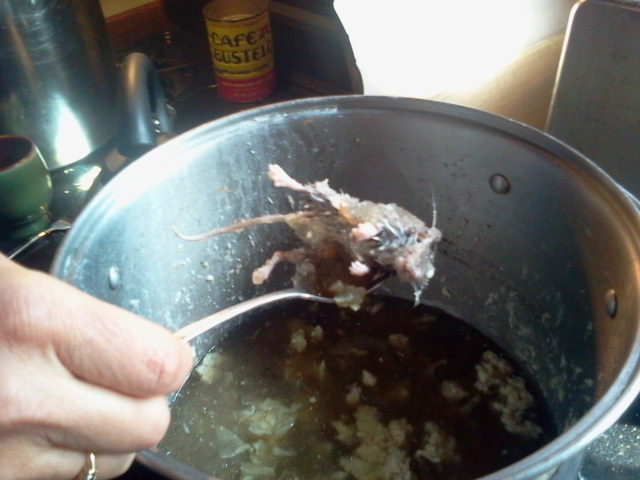
One of the things I love about the cold is that our mudroom becomes a large food storage area. Right now it merely keeps dishes very cold, but soon I can count on it to freeze foods as well. It is nice to be able to store a leftover soup safely overnight lunch.

One day we brought in a soup to thaw. Besides the frozen chicken we found some protein I had not placed in it myself.

soup to die for

Poor guy.

Posted in Stories of Home | 2 Comments

Thoughts on “Don’t Stay In School”

The other night I told my friend Katharine about David Brown’s scathing rebuke of education in England. She experienced the English school system herself. To my surprise, she confirmed important parts of his critique. When my 15 year old son brought it to my attention, I was defensive because after all, I am the one who inflicts on him his homeschool education. Many of the elements Mr. Brown disses are things I consider necessary to good education; many of the things he complains are missing are taught to every American teen, several times, whether they listen or not. I thought he exaggerated.

Watch this: Don’t Stay in School Video (3 minutes)

To recap: he says his education covered dissection of frogs, the quadratic equation, isotopes, mitochondria, abstract and mental math, cursive, hues of light, Old American West, the wives of Henry VIII ad nauseum.

He says it didn’t prepare him for getting a job; he wasn’t taught about personal finances, economics, the English political system, English law, human rights, first aid, mental health, current events, how to raise a child.

I was astonished when Katharine confirmed English education does not teach about English government. It does nothing to prepare the English children to contribute to society. In contrast, some accuse American schools of dwelling too long and too frequently on how our government works. In our home-centered program, Classical Conversations, freshmen read original documents; they outline and memorize the key points of the Constitution. Any country in which its people have a voice in its government ought to train them. To omit this seems…odd.

My first impression of his video was that he was yet another young twenty-something ranting about how bad he has it. The easiest thing in the world is to critique and tear down. He is a gifted fellow but he uses false dichotomy: e.g. either the solar system or the political system. Concepts long considered a part of traditional education he would cut. Science and Math take the largest share of criticism.

I don’t believe he really wants a utilitarian education, one that merely trains a child to become a worker. Since he is an artist, I know he expects an education to develop the human soul, and that includes encouraging curiosity about the natural world. Pure science values knowledge for knowledge’s sake but this is also the foundation for applied science. We dissect frogs and study mitochondria so we can understand and take care of our own bodies. First aid principles are rooted in human anatomy. Though I graduated from high school almost 40 years ago, I still draw on what I learned in Biology for taking care of my family.

Likewise, abstract math trains the mind in problem solving, creative thinking (since once you know how numbers work you can get to a solution in more than one way), accuracy, care for details, and logic. It has the delightful quality of having absolutes; there is an answer and I can measure my success against it. I am right or wrong. Even as I go through Algebra II again this year so I can be a better tutor, I feel real joy and a sense of accomplishment in getting right answers. And yesterday I was able to derive the quadratic equation on my own. I pinned it to the ground! So satisfying.

Since he doesn’t complain about literature (except Shakespeare) I assume he does see how important it is to explore our humanity as characters wrestle with the big questions of life. If I were to help him write the constructive counterpart to Don’t Stay in School, I would list Philosophy as essential to a good education. We aren’t workers; we are humans who need to treat ourselves and others humanely. We need to know how to think about how we live.

Education is for training us for life as an adult in a complex world. The best education trains the student to learn so she will be able to teach herself anything she needs going forward. She will not be limited; she will be free. That is the meaning of the Liberal Arts, the arts that make man free. A truly classical education has this goal.

I hope Mr. Brown’s anger and curiosity lead him to discover the classical liberal arts education, and that he may someday be able to train his own children in it. Maybe his ideas will be heard by those who have the gift of making ideas concrete and his video will lead to school choice for the next generation of English children.

This video teaches me gratitude for the deep blessings of a homeschool. I am so glad I am having a second chance to become truly educated. A classical education has taught us priceless lessons and has equipped me and my children to learn for life.

Posted in Art, Classical Conversations, classical education, writing101 | Tagged , , , , , | Leave a comment

This morning’s reading distilled to 50 words

He was about to be executed.

He wrote, “Be joyful! Don’t be afraid of anything but ask God for everything you need, giving thanks for everything you can.”

Live confidently in the moment because life is a string of moments that runs through the moment of death into eternity.

Posted in writing101 | Tagged , , , , | Leave a comment

Over a Virtual Pot of Tea

If we were having tea together I would tell you I am cutting sugar to 25 grams a day so I can kick a sugar addiction. I know getting hold of my health would have the greatest effect on my sense of well-being. I don’t want to be controlled by anything.

If we were having tea together I would tell you about my current efforts to get two kids in college next year: one to art school and one into Vermont’s dual enrollment program. My husband and I are going with our daughter to Maine College of Art to visit the school. He has a hard time thinking of taking on debt for her, since she is unlikely to be saddled with the complications of excessive wealth. I assured him there are plenty of ways for a skilled artist to be employed. She has a realistic view about the difficulty of setting up shop as a freelance artist. MECA already accepted her portfolio at a Portfolio Day recently, commending her on her advanced technique. (Her art teacher, Suzanne Nielsen, teaches classically.) They want to see her develop her own voice and I think they will help her do just that. It is easier when you have a good foundation.

If we were having tea together I would tell you how much I am enjoying writing for my blog. When I wake up, the thought of writing for my latest assignment makes my heart leap. WordPress has a Blogging University, offering several classes that challenge writers and provide an online community. I am taking Writing 101. The prompts not only suggest formats and topics I have not used, but also instruct me in some WordPress features. I still feel like I am talking about myself all the time and I would like to discover how I can serve the online community in some way.

If we were having tea together you would catch me up to date, and I would listen closely to what you struggle with and what tickles you. I would love to give you a safe place to unload. I imagine you dumping on the table all your clutter from a messy bag (your baggage, see) and sorting through it piece by piece, deciding what is trash and what is not. Maybe you’ll pack your load better after confiding in me.

If we were having tea together I would tell you how my older children are doing and how proud I am for making wise decisions. I would tell you about my youngest children and that I did not expect their education to actually be better than the ones who had a young homeschooling mother. I would tell you how grateful I am for Classical Conversations, and how it helped us all to relate every subject to the big questions addressed in philosophy. They are all going to be okay.

If we were having tea together I would serve my very own gluten free scones, small enough that I could have one and jam with it and not go over my sugar budget. I miss the scones from Rose Arbour, our local tea shop, and figured out how to make something not entirely unlike Suzy’s scones. I might not tell you they were made without wheat, but it would make me smile to watch you enjoy it. It’s good, yes?

Let’s do this again soon.


Posted in Stories of Home, writing101 | Tagged , , , , , , , , , , | 3 Comments