The Spice of Life

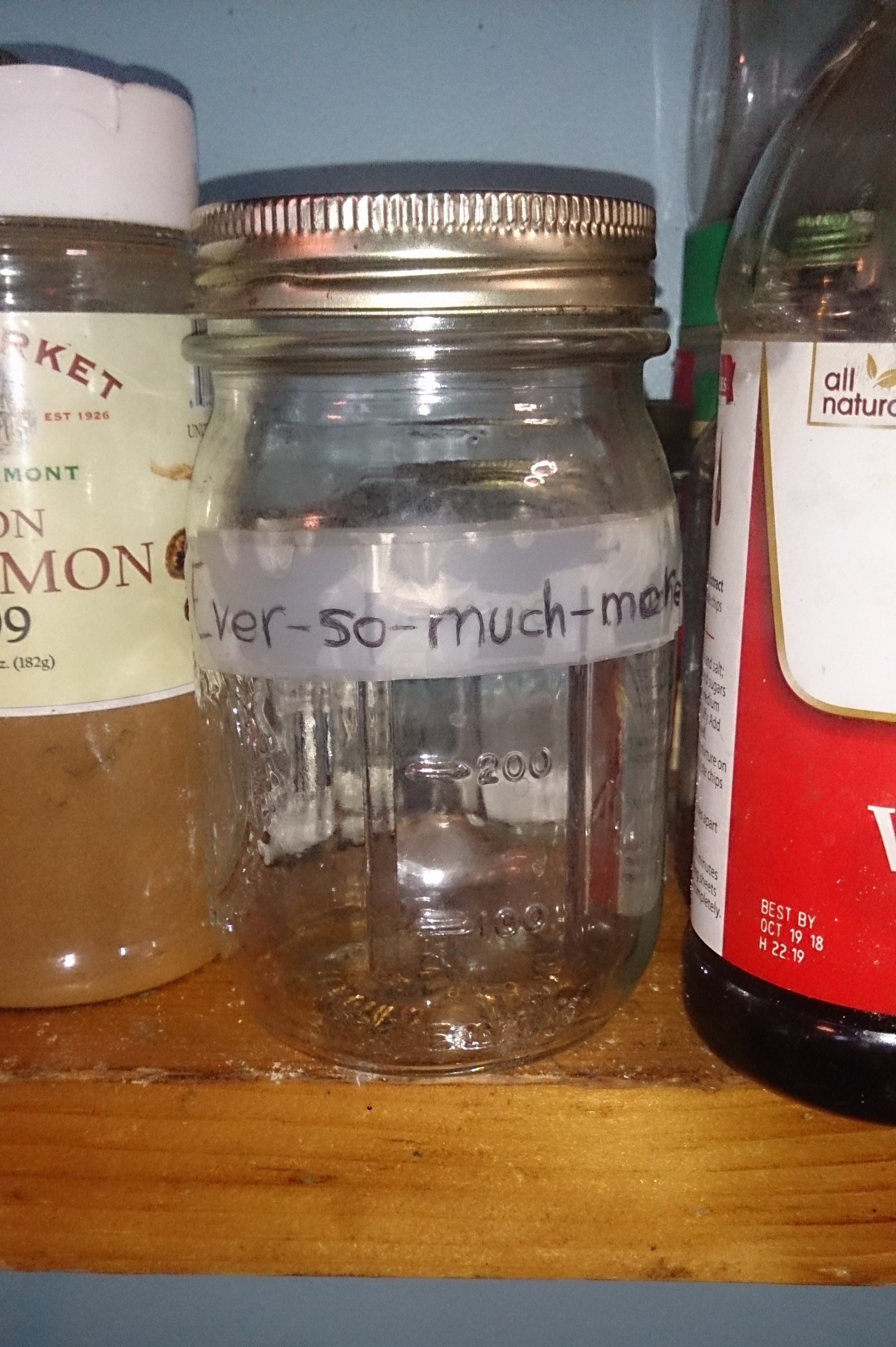
This morning I made my last batch of gluten free zucchini bread. And as I gathered my powders, both white and brown, bitter and aromatic, I found this at the back of my shelf:

ever so much more so crop

Ever-so-much-more-so

Do you know what this is? It is the colorless, tasteless, scentless product which enhances every sensory experience ever so much more so, sold by Professor Atmos P. H. Ear to the unsuspecting citizens in “Ever-so-much-more-so”, a Homer Price story from the book Centerburg Tales. Ever child should read the Homer Price books by Robert McCloskey, or better yet, enjoy it as a family read-aloud.

My (then) young daughter, Sylvia, planted it on my spice shelf long ago, tucking it in the back so I should discover it one day. I laughed then and I smile every time I see it now because, of course, I have not removed it. I love the intersection of a good book and ordinary life.  My picnic basket links us to The Wind in the Willows, and Molly’s homebuilt wardrobe draws on The Lion, the Witch, and the Wardrobe. Our homestead was inspired by My Side of the Mountain.

I am so glad, so deeply grateful for our homeschooling experience which has woven such stories throughout our days. And blessed by the children who have taken to the stage so comfortably to improvise with us.

I once lived with a strange woman who accused me of living in a fantasy world. Maybe she was referring to my habit of wearing Edwardian walking skirts and lacy petticoats, back when it suited my position as a schoolmarm in Montgomery County Public Schools in Maryland, long, long ago. Let’s just say I never did feel I needed to conform to the shifting values of the culture and felt free to choose the best of any era. And in the face of her belligerent insistence that I needed to go get psychological help (she having done me the favor of already explaining my case to a psychologist who was waiting for my call) I thought, “If this is reality, dear God, I choose to write my own fiction.”

And that is true today, ever so much more so.

Posted in Stories of Home | Leave a comment

Breaking My Math Fast

A couple of days without math and I am feeling itchy and unfulfilled. I am working through the last half of Saxon’s Algebra II in order to start Advanced Math after Thanksgiving. The boys and I work silently at the table on our 30 problems for about an hour and a half. It feels exactly like the clean burn after a sweaty exercise, without the need for a shower. It makes me feel stronger all day, and this week after missing a three days I feel the restlessness to get back in the zone.

I find this a bit of a surprise.

Posted in classical education | Tagged , , | 1 Comment

A Little Excitement Today

You have to understand my son likes to sit in the backseat of the minivan and prefers to ride the 50 minutes to Classical Conversations in silence. Sometimes Abraham reads for class; sometimes in the rear view mirror I see him drooped in sleep.

We were a few minutes late but I had to stop for gas. I had enough to make it to exit 8, just over half way, where the Irving station offers the best prices. John, sitting in the front seat, intently read up on the Hudson River School painters, while I got out and pumped gas. No one spoke; we were congenial in our silences. I should have paid attention.

Tank filled, I got in and drove through the rain to White River Junction, two more exits up the highway, each ten miles apart. And when I pulled up to the door to let the boys unload their crates near the portico, John and I were stunned to realize we were alone.

Abraham was not sleeping in the backseat; the backseat was empty.

Instantly we knew where he had to be–back at the gas station–but we could hardly believe it. So, John took his stuff to class and I hit the highway. My son was twenty miles away.

Now, keep in mind he is a teen, not a child, so I was confident I would find him waiting for me. But he did not know what to expect of me. Would I notice he was gone before I reached exit 9 and so turn back? Or go all the way? He called home to get my cell number from my husband (using the gas station’s phone since he does not have one) but I never got it. Abraham waited for 45 minutes, crouching on the rain-wet grass, watching every car coming from the highway. And that is how I found him when I finally pulled up.

We had a good laugh, and I am thankful he is such a level-headed young man. But I don’t ever want to do that again!

Posted in Stories of Home | Tagged | 3 Comments

You’ve Got Personality

The other day my 25 year old son told us about the personality tests he had taken at work. Management at his company hired someone to administer the full Meyers-Briggs Type Indicator (MBTI) assessment to the staff, and then followed up with a seminar to explain the results. When Ben told us how much insight this gave him into his struggles and strengths, we immediately looked up a site and read the description of his type. Laughing in amazement, we agreed it pretty much had him pegged, and that no other type hit it so well.

The result of the MBTI (or its imitations) is a four letter “type” identifying on which side of neutral you fall on four dichotomies: Introversion (I)/Extraversion (E), Intuition (N)/Sensing (S), Thinking (T)/Feeling (F), Judging (J)/Perceiving (P). The Meyers-Briggs site explains them here. This may be enough for the reader to determine what type she is. Please read the whole page because it introduces the Meyers-Briggs personality theory well.

When I read it I was easily able to recognize which side I fell on some, but not all, of these poles. I found a helpful site, http://www.16personalities.com. This site has a slightly different approach to personality typing, explained here. I took their free personality test.

It is no surprise that we all have gifts that vary from our neighbors, but you may object to being sorted into one of sixteen tidy categories! I know, I know. Some of us do not take kindly to being classified and stuffed in a folder labeled, “Just like the Rest”. But I find the personality typing helpful in two ways: it validates my own experience, and it gives me insight into my most important relationships.

Two benefits of personality typing

Have you ever been excited because you found a member of your tribe? Anne of Green Gables called them “kindred spirits”. When I read the description of my type, INTP, I felt wonder, mingled with relief. It validated my experience. It explained so much, such as why I was often called “intense” as a young woman, why ideas seem like candy to me, and why I study a subject deeply and then want to move on to something new. It may explain why I am such a blockhead when it comes to wine-tasting–I live more in the inner world of ideas and my senses are not so nuanced.

The second benefit of knowing your type and those of your closest relationships, is the possibility for greater cooperation. Knowing the types of my children helps me understand their needs, especially where they differ from mine. My ENTPs thrive on challenges and new adventures; the INFP needs more attention to her feelings than we thinkers tend to give. Also, when one’s weaknesses match another’s strengths, there is potential for a new way of dealing with friction. I am rethinking the way we distribute our work.

For example, I needed to renovate my boring perennials garden. I researched garden design online and took copious notes. I made a template of my garden space and carefully diagrammed a new arrangement. But the task of implementing it overwhelmed me and I stalled. However, when my husband’s test revealed him as an ESTJ, “The Executive”, I realized how perfectly he is suited to the garden challenge. He built our entire house and I often marveled at the mystery of that accomplishment: How did he stick with such a monumental task for so long and take it right through the cleanup? Why, he is powerfully gifted for tasks of this magnitude. So, this weekend I sat with him and explained my design, and he easily came up with a plan to do it. He used his tractor to prepare a second garden space for my excess divided plants and my work from here is easy now.

You may not have felt it from where you are, but my paradigm just had a major shift along a fault line. This private, solitary-minded wife now knows I need to uncover to him my thoughts, in their researched and developed maturity, so that he may put together a plan to execute it. Considering that for years I have had good ideas but failed to convert them to action, this offers the hope of success, where, to be honest, I saw myself alone on an island with bridges burning in every direction. I’ll get in his boat if he lets me help navigate.

Do we really need more labels?

When you read the type descriptions at the somewhat pop 16personalities site, your inner cynic may say it sounds like a horoscope. But keep in mind it is a popular version of the serious work done by the Meyers-Briggs foundation. I respect the science which went into this discovery, and it is as much a discovery as Germ Theory, or perhaps the syllogism, the pattern of how we reason. The tests are valid and reliable.

You may also wonder when you take the test how you should answer: Do you consider a lifetime of growth or answer as you are today? The older we are, the more adaptations we have made for our weaknesses. Perhaps we are not so polarized as we were in our teens. But according to the information on the instrument’s reliability, regardless of your mood or frame of mind the results will be essentially the same. If you are someone who is constantly striving to improve and feel like you are reinventing yourself all along your journey, consider your behavior of just the last few years when you answer. When I retook the test, not so timidly as the first, my type was the same; only my percentages changed.

And where is Christ is all this?

As the Christian is “transformed by the renewing of [his] mind” he is going to change. I am pretty sure my scores near the center on three scales reflects growth and maturity that come of walking with Christ for over 30 years. When the Lord says, “Love one another” you don’t whine, “I’m not cast that way.”  We are all called to certain behavior whether it is easy for us or not. The two laws are still the same: love God with heart, soul, mind, and strength, and love our neighbor as ourselves. The types don’t create something new; they name what is already created. Because typing seems to explain so much so well, the temptation is to define oneself by the new label. No. Those of us who have died in Christ belong to Him, and He to us. Who we are in Christ will always be more vital than the gifts He has given us for His work.

Why did I write this?

So, what my family has learned I share with you. (And I have discovered that is one of the consistent traits of my personality type: passing on what I have learned!) The Meyers-Briggs personality typing helps us understand how we perceive the world and make decisions in it, and it can provide insight into our closest relationships. Take the test. Do the results ring true for you? Comment below.

Posted in Stories of Home | Leave a comment

#TBT Organic

“I want to be a part of something bigger than myself.” I hear this more and more lately, an expression of our natural desire to know meaning and purpose in our lives.  Granted, some people seem to be satisfied to know where their next burger is coming from, but most of us feel this restlessness.  What is out there? Is there something worth living for?  Am I all alone?  How do I make the important decisions when I don’t know where I am going? Who am I?

Today I gathered with a group of people, a diverse mix of ages, education, nations, color, occupations.  But they fell in two camps: male and female.  In each, there were those with high voices, and low–four parts. We sang together, each taking one part. And I thought how marvelous it was to be a part of this living organism, this vox humana, a organ made of voices.  My husband next to me sang the bass parts, providing a solid structure of chord roots and walking smoothly between them. Women sang the high part, the melody, which played off the foundation of the basses.  Altos, the low-voiced women, filled out the chord in important notes, and the tenors, that rare breed of musical high-voiced men, contributed to the chords while supplying the excitement that is inherent in a male voice singing in his upper range.

Together we sang one text, in one rhythm, with one heart. We were singing off the same page, you might say.  There was a place for everyone, even Freddie, the Down’s man who plays harmonica because he can’t read or sing and never will.  There are men who are bewildered by part-singing, but know the tune, and so that is what they sing.   There is no screening for this choir but we all look forward to it with joy. Where do people sing like this anymore?

Some say hymn-singing (for that’s what this is) is too hard, out of fashion, or even elitist.  Better, some suggest, for all to sing melody, which symbolizes that unity we desire in our fragmented and hostile society.  Put a band in front and everyone can sing with them. My heart always droops in sadness when I stand in a crowd and redundantly sing over the leader.  I can’t hear my neighbor, and I can’t even hear my own voice sometimes; I am part of an audience in a sing-along competing with amplified instruments. If I have the sense I am part of a whole, it is as a nameless, voiceless component. I neither sense my individualism nor my part in the whole. While the experience represents a unity, there is no sense of our diversity. My contribution is meaningless.

Today, as I breathed my phrases, singing in complement with Judy’s soprano and Robbo’s bass (the elusive tenors don’t sit in near me, alas), I felt the surge of well-being I often experience at these times.  Picture a spark in each of us, fanned into a flame by our breaths, creating a crackling, light-giving fire. Not just a comforting fire on a cold day, though it is that too, but the purifying, cleansing fire of people who acknowledge their sin before a holy God, and open their lips in praise of Him.  We hear the diversity of parts but sense our place in the living organism of the church of Christ.

It is in hymn-singing I most connect with the organ that is the church, a living body that needs all its parts.  Thanks, my brother and sisters, for adding your set of pipes.

Posted in Art, Stories of Home | Tagged | 2 Comments

Night Out with the Girls

I don’t think we had even ordered our entrees before I shot the question, “What is Art?” We call ourselves the Three Graces, and each is an artist: one is a novelist, one is a professional equine artist, and I write music when I can. But all of us encounter art and each has formed a framework for evaluating it.

I asked, “What is Art?” but just as a preparation to discuss what makes good art. I wanted to see if we could discover some objective standard of measure. If my reader is inclined to think such an idea elusive or even arrogant, consider that we have objective absolutes for human behavior. We think it is objectively wrong when a nation’s head takes advantage of his position to oppress or murder his people.  We jail those who by virtue of insider knowledge benefit from the stock market. We abhor violence done to the innocent, and for now, sexual activity with children is still considered an absolute wrong. (The fact that a society can convince itself to accept abhorrent behavior does not do away with those timeless absolutes. It just makes the society insane with cognitive dissonance.) Since some absolutes exist for human behavior, perhaps there are some for art, the product of human behavior, as well? Somebody wields some measuring stick when deciding what pieces to display, for example.

At first we found it easy to agree. We came up with a loose definition: Art is the intentional work of the human executed with some degree of skill, a communication between artist and recipient, and bearing some thoughtful relationship to order and beauty. Regardless of the art form—painting, poetry, symphony, dance, woodworking, photography—the artifact communicates through the skill and intention of its maker and the beauty (or lack of it) is expressed through deliberate order imposed on the natural world.

But we found it much harder to identify what makes an art piece good. What is good art? Sometimes I encounter a piece that makes we wonder if I am staring at the Emperor’s new clothes, the hoax played upon king and courtiers too intimidated to speak the truth, uncovered by a child too young to succumb to sophistry. I believe we are meant to exercise discernment when we encounter art.

I dismiss out of hand the philosophy that every product of an artist is art or that it is good art. What is the distinction between practice work and final product? Every essay I write begins in a very rough stage and takes deliberate shaping before I publish it. When a young musician fumbles through a piece he hardly knows I can listen politely but I discern what it is: practice at best, and not yet good art. An artist’s preliminary sketch may exhibit skill and beauty but lacks that intentional bit. It is not yet that robust communication ready for an audience.

Duchamp’s “Fountain” (a urinal) and John Cage’s 4’33” (four and a half minutes of silence at the piano) raise these questions in my mind. Just because the artist or the gatekeepers of the Art world call them art, must I as well? Is it good art? Neither exhibits any skill. They lack deliberate ordering, in the former because the order was imposed by the manufacturer, and in the latter because the random sounds were in no way under the control of the artist. Both artists made no attempt at beauty.

They did, however, communicate. They made philosophical statements. And I have heard, “Well! At least it started a conversation!”

The last time I heard this I could have smacked the guy through the phone. In my position with an education company I had to evaluate essays for hundreds of tutor- in-training, as they prepared to teach the classical essay (think Aristotle, not the average English class). Since it was a new model for most parents and students, it meant stripping down to a bare-bones essay for the first paper. Almost every tutor understood the ultimate goal was to teach students to write in this ultimately sophisticated form, but a few could not, would not yield to the small beginnings of this essay assignment.

One man sent me his essay. It went something like this, “This is a stupid program for three reasons: any idiot can write the essay without reading the program, the writer can come up with supports for his statements without any kind of prewriting, and my essay meets the requirements just as well as if I had been trained by the program.” He then followed his thesis statement with three paragraphs that fleshed out his clever, clever idea.

When I called him to discuss it and to explain why I could not sign him off, he used that argument. “See? We’re having a lively discussion! Therefore, my essay is valid.” But I ask you, what kind of experience is it when you totally piss off your audience? That man demonstrated utter contempt for his reader. I find that a despicable attitude in an “artist”. I suggest true art is always an act of love between artist and recipient.

Two quotations about that relationship come to mind. P.G. Wodehouse, that master of metaphor, says,

“I believe there are two ways of writing novels. One is mine, making a sort of musical comedy without music and ignoring real life altogether; the other is going right deep down into life and not caring a damn.”

Ray Bradbury understood the necessity of love for art,

“Love is the answer to everything. It’s the only reason to do anything. If you don’t write stories you love, you’ll never make it. If you don’t write stories that other people love, you’ll never make it.”

Well, my friends and I talked through our excellent Italian entrees, panna cotta, and Wild Blossom Honey gelato, and out into the street after the restaurant closed. I love these women, these artists, who after all are doing something meaningful with their craft while I dabble with writing. (Does it count that I am attempting a fugue?) They humor my attempt to find some absolutes in the arts and they know I am working out my ideas as I argue. They make it a lot harder for me to dismiss a work as bad art and inspire me to spend more time with the best.

Posted in Stories of Home | Leave a comment

Robbo’s Fresh Garlic Pickles Recipe

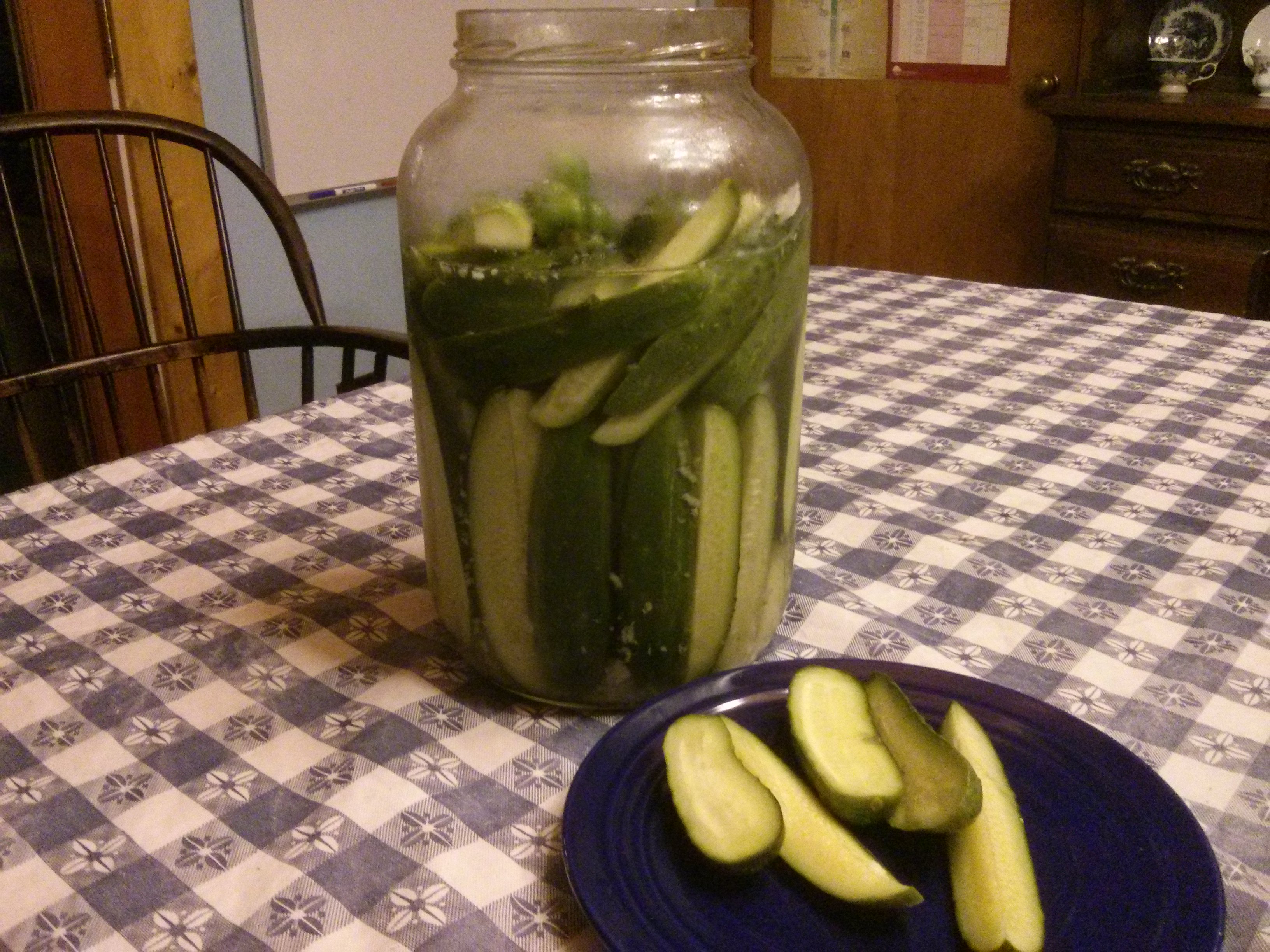
Robbo's pickles are ready.In cucumber season, whenever we go to a party, Robbo brings a gallon jar of his garlic pickles.  They are crisp, just salty and vinegary enough, and zippy with garlic. Everyone likes them, even people who say they don’t like pickles and are pretty much forced to try one anyway. This is his recipe.

First, cut your cucumbers into spears. We like pickling cukes best but you can use salad cukes too. Cut the large ones into six spears, medium into four, and small ones in half. Pack the cukes into a one gallon jar. (You can do this by the quart, if you like. The brine can be adjusted proportionately.)

For a gallon, sprinkle on top three tablespoons of sea salt, one teaspoon freshly ground black pepper, and about a quarter cup of freshly pressed garlic. (Really.)

In a separate bowl mix one part white vinegar with two parts water. For the gallon it is usually about 5-6 cups total, depending on how densely he packed the jar. So, about two cups vinegar, and four cups water. Pour this over the salt, pepper, and garlic to fill the jar. Cover and shake to combine.

Chill in the fridge. They are ready the next day. Enjoy them over several days, or eat them in one sitting with a group of friends.

Posted in Stories of Home | Leave a comment

Facebook, I am breaking up with you.

In my senior year of high school, during our study of Walden, I spent a week without any TV as part of a project. I realized then how much I craved it; one desperate night I sat around the corner out of sight listening to Dad’s football game. I didn’t even like football.

Since 1977, then, I have lived without TV. When I wasn’t teaching I was writing music, writing letters, riding my bike on adventures, and having dinner parties with friends. I married a man who was too much an outdoorsman to watch life vicariously through studpid sitcoms, so we continued to build, create, read aloud, and send out original Christmas cards with our Year in Review in humorous verse. It wasn’t until I had my third baby in 1994 that I gave in and got a used VCR player for a small black and white television. 101 Dalmatians made a riveting babysitter. Now, 21 years later, we have a modest sized TV on which to watch movies, but more than one computer screen for each person in the house.

And I hate it. It stifles creativity, and the offerings of our bucolic location are no competition for Minecraft and Facebook.

I have two temptations when the internet is slow and I am waiting for something to load. One is to check out the news. Now, there is a cesspool that always fouls my thoughts. A swim in that water and my thoughts reek for hours, as I ruminate on the injustice and suffering sensationally posted there. Google News, you’ll get no more clicks to tell you what I am reading.

The other is to look in on Facebook. I have learned Facebook always sucks 45 minutes out of my life. I can skip over the cats, and pathetic pleas for someone–anyone!– to demonstrate friendship by posting a word. But there is no end of people to congratulate, comments to Like, and thoughtful articles to read, Like, and Share.  Yikes! At the end of the day I kick myself for not getting another chapter read in a book I am outlining, and for doing nothing original or creative.

I have this taped over my laptop screen now: “One of the best and fastest ways of acquiring knowledge is to insist on remaining ignorant about things that aren’t worth knowing.” –Sydney Harris, from The Happiness Project, September 4.

Facebook, I am moving on. I’ll watch your future career with interest and may peek in to say hello after a few weeks. But I will not allow you to rob me of more of my life.

Posted in Stories of Home | Leave a comment

What I Did for My Summer Vacation

Well, my friends, it has been a long time. The constant tug I feel for spinning thoughts into poetry (of one kind or another) sometimes performs work of a different kind. This summer it generated letters with actual stamps, an ongoing gratitude list, and notes in my kitchen lab notebook when I am working on perfecting my gluten free scone recipe.

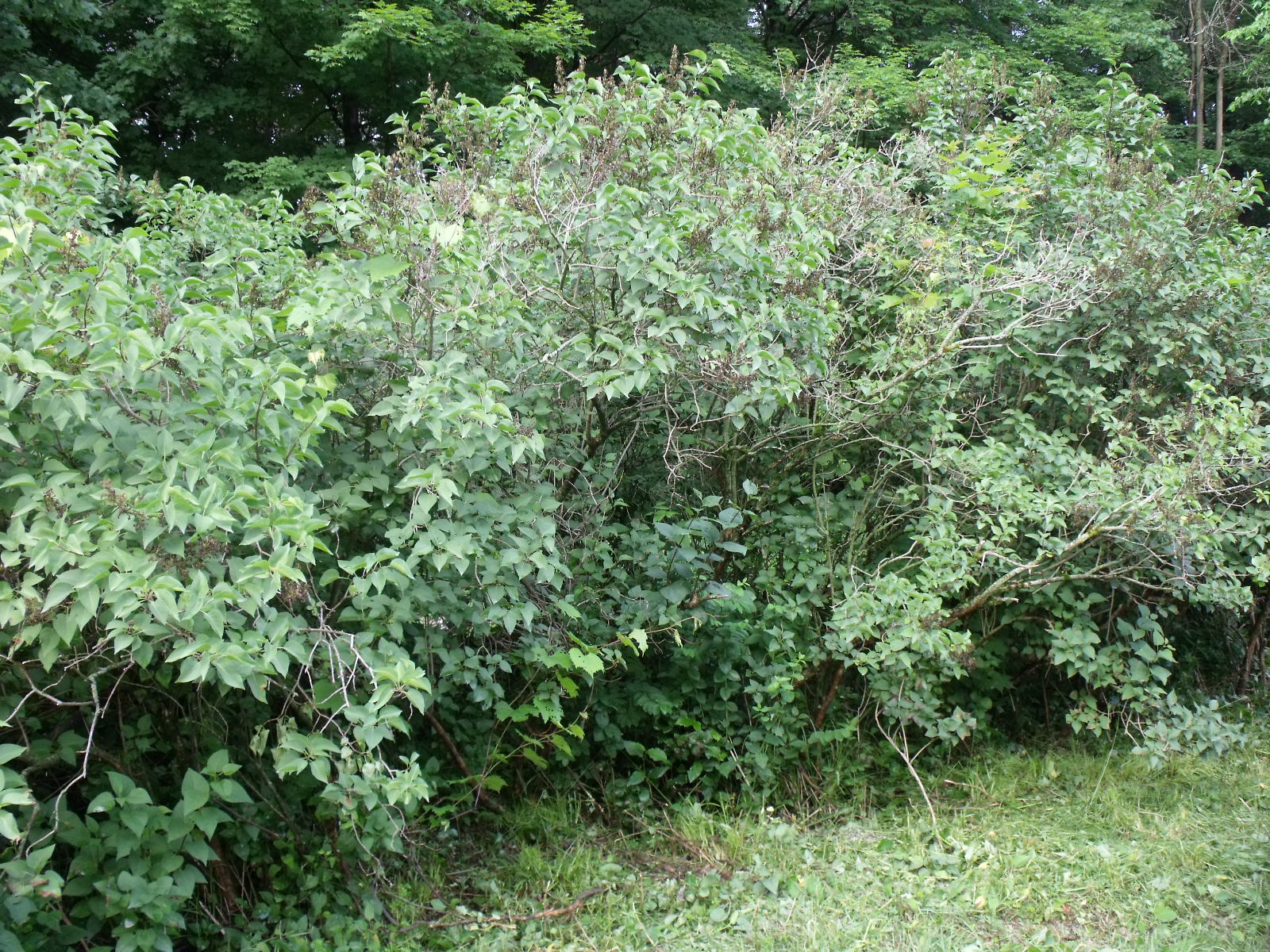
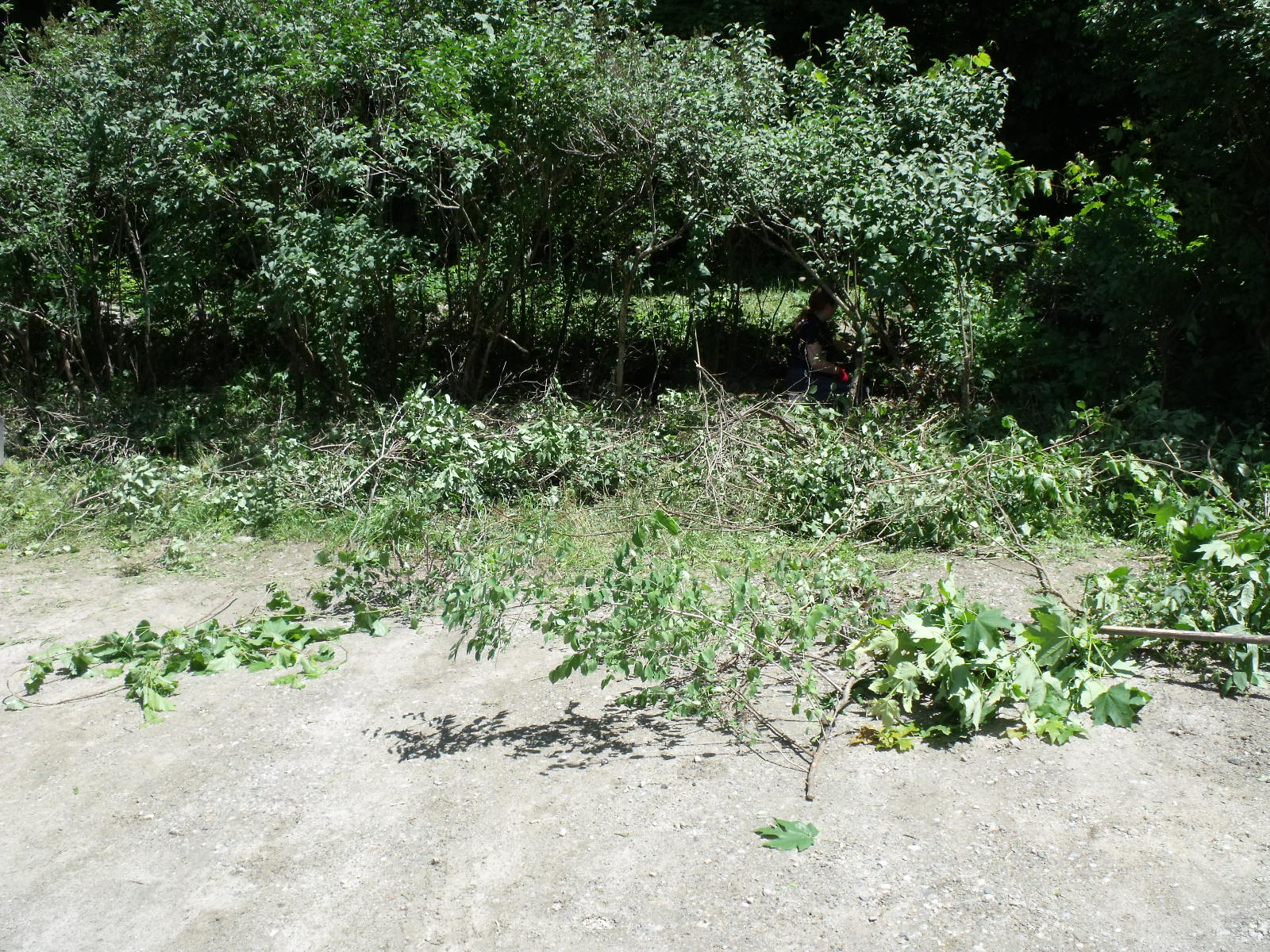
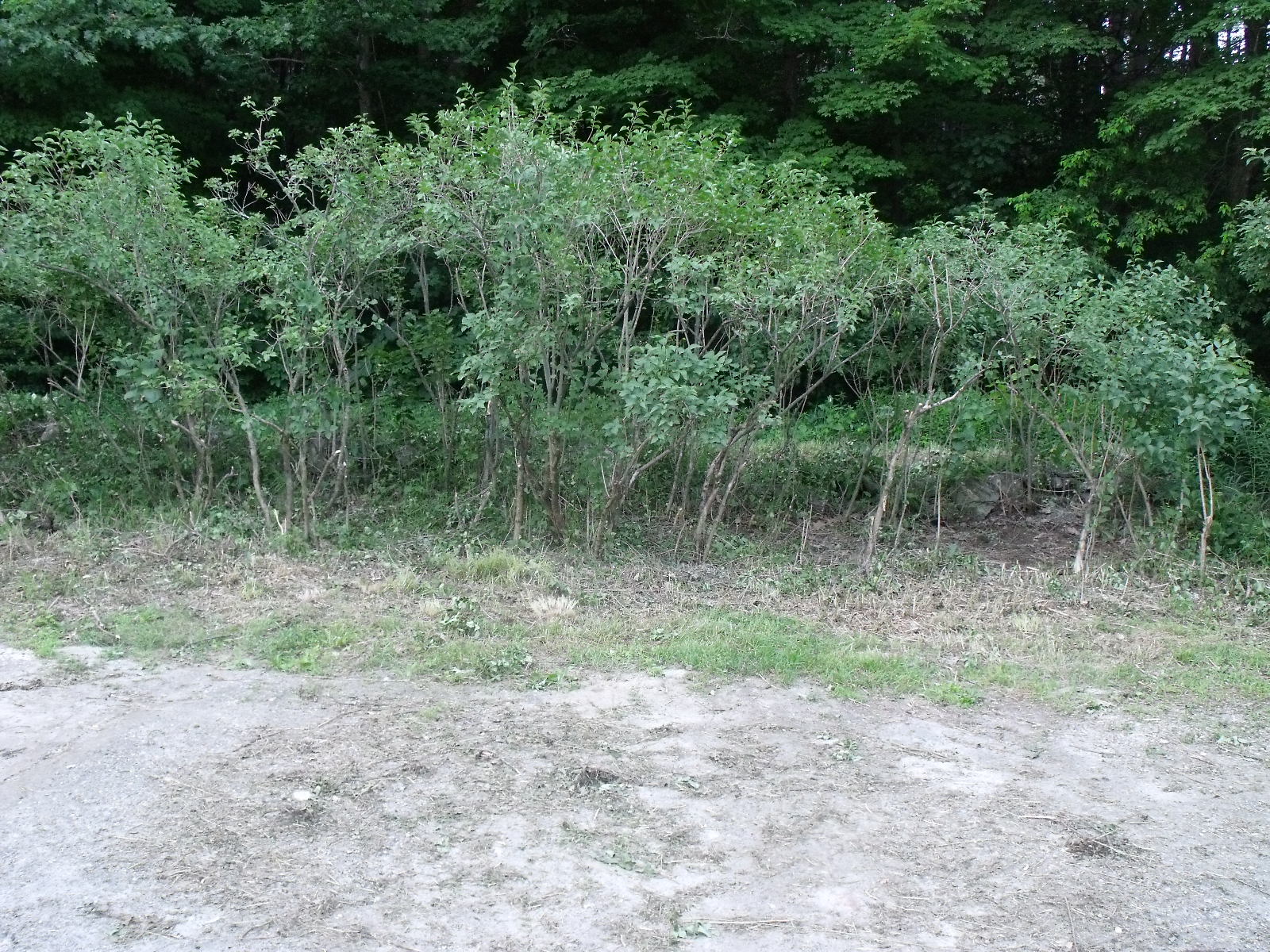
This has been a summer for creativity, for sure! I whacked my wonderful-horrible lilac hedge back until it begins to look like a grove.

Lilacs before.

Lilacs before…

...during...

…during…

Lilacs after sculpting

It shows a lot of promise. In three or four years the bare branches will fill in and I will be able to trim them back from their towering nine feet height. In May, if I can reach the spent blossoms and clip them, I prepare them to bloom profusely the following year. For me, the five days of lilac blossoms is the high-point of spring after a dreary winter.

Another transformation this summer came about when I read the book, the life-changing magic of tidying up; the Japanese are of decluttering and organizing, by Marie Kondo. This video is my favorite.  In one day I reduced and sorted all my clothes. Now I can get in my closet and drawers! It took me three weeks to go through 1700 books, but I did that too, saving several hundred but packing up 43 boxes to donate to the Five Colleges Book Sale in the spring. With deep satisfaction I work in my minimalist office. Kitchen tools are next, but already I experience more creativity because thousands of belongings are not clamoring for my attention. I thanked them for their service and sent them down the road in the green-and-white truck.

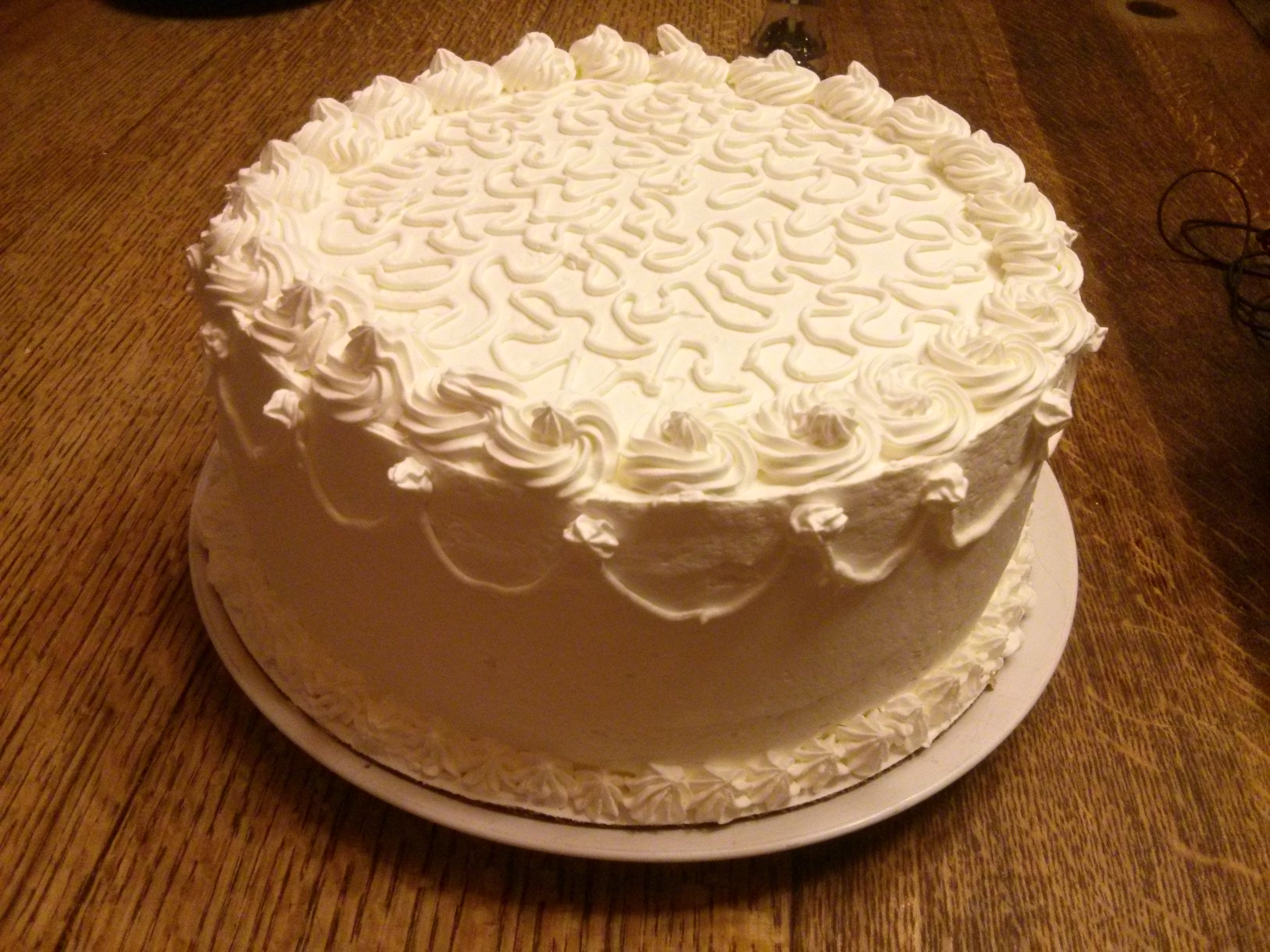
I never saw this one coming: lately I have taken a leafy byway into cake decorating. Ever since Molly had me make her chocolate stout cake and I made a second one gluten free (so I could have a slice), I have been playing with cakes. Recently I rediscovered The Wedding Cake Book, definitely one of my top ten cook books, and tried the Italian Meringue Buttercream. In spite of it being the hottest, most humid week of the summer, it worked (eventually) and I used it to cover a gluten-free zucchini cake, decorating it with the tools I had just bought.

This is my first experiment with decorating tips. It is white because I have no coloring yet!

This is my first experiment with decorating tips. 

Since Classical Conversations wrapped up in May I have also traveled, in various family configurations: Chattanooga for Molly’s graduation, St. Johnsbury for the practicum, Acadia for family camping adventure, the Poconos for the annual family reunion, and two trips to Rhode Island’s seashore. All of this by car. By pedal power I have pulled my heavy hybrid almost 500 miles.

And now that the school year has started I am working at the table with my teens. I have some wiggle room for these projects and creative moments. After six years of tutoring, this is the first in which I am “just a mother”. I attend in the back of the class on Tuesdays, marveling at another tutor’s approach, and sometimes I run some errands because I CAN! (That is me raising my voice in glee.)

So creative! So much energy! So much more sane!!

Lately I have been getting up about 5 a.m. again so I can play with a poetry prompt and then dig into my Bible study of Colossians before I get to the business of the day. If I let you read what I write you would say, “Terence, this is stupid stuff” but I have to start somewhere. A former student is  teaching the boys and me how to have a morning workout routine. Those six feeble pushups I do from my knees? Those are like my poems. Small beginnings.

What was the most significant thing about your summer this year? I would love to know. post in Comments below.

Posted in Writing about writing | Tagged , , , , , , | 2 Comments

The Branding of a Disciple

Today the pastor read the 20th chapter of John. When the narrator spoke of “the one Jesus loved” I suddenly read this differently than I have all this time. I always took this to be John modestly–and not so modestly–referring to himself. Modestly: he doesn’t mention his name. Immodestly: he is the only one that Jesus loves? Jesus loves him more than the others? Really?

But this morning I was struck by how similar this is to what Paul says of himself, that he is “chief among sinners”. What if John identifies himself in his thoughts constantly as “the one whom Jesus loves”, out of a sense of awe and amazement?

  • Yeshua loves him, a sinner. (He was, after all, part of the squabble about which brother deserved the greater honor.)
  • Yeshua loves him. (The books of John and 1 John are particularly emphatic about God’s love.)
  • Yeshua loves him. (John knows Jesus was man, testifying he saw and heard and touched a real body. But he also knows Jesus is the fullness of God, the Logos enfleshed, chesed and emeth (grace and truth) embodied.

Paul says, “Be transformed by the renewing of your mind.” He says to dwell on the virtues (whatever is good, noble, pure, lovely, excellent, praiseworthy…) that we are to imitate. He says, “Take every thought captive to Christ.”

The fact is that we are sinners. But the truth is that we are the ones Jesus loves. Which idea has the power to transform? Which one identifies me most truly?

That I am a sinner I’ll never forget, but that I am in Christ I shall always confess.

“Who are you?”

“I am the one whom Jesus loves!”

Posted in Stories of Home | Leave a comment