Light

When we encounter a season of gloom, light becomes powerful. Now that I rise well before dawn, the first thing I do in the dark house is light an oil lantern on the dining room table.

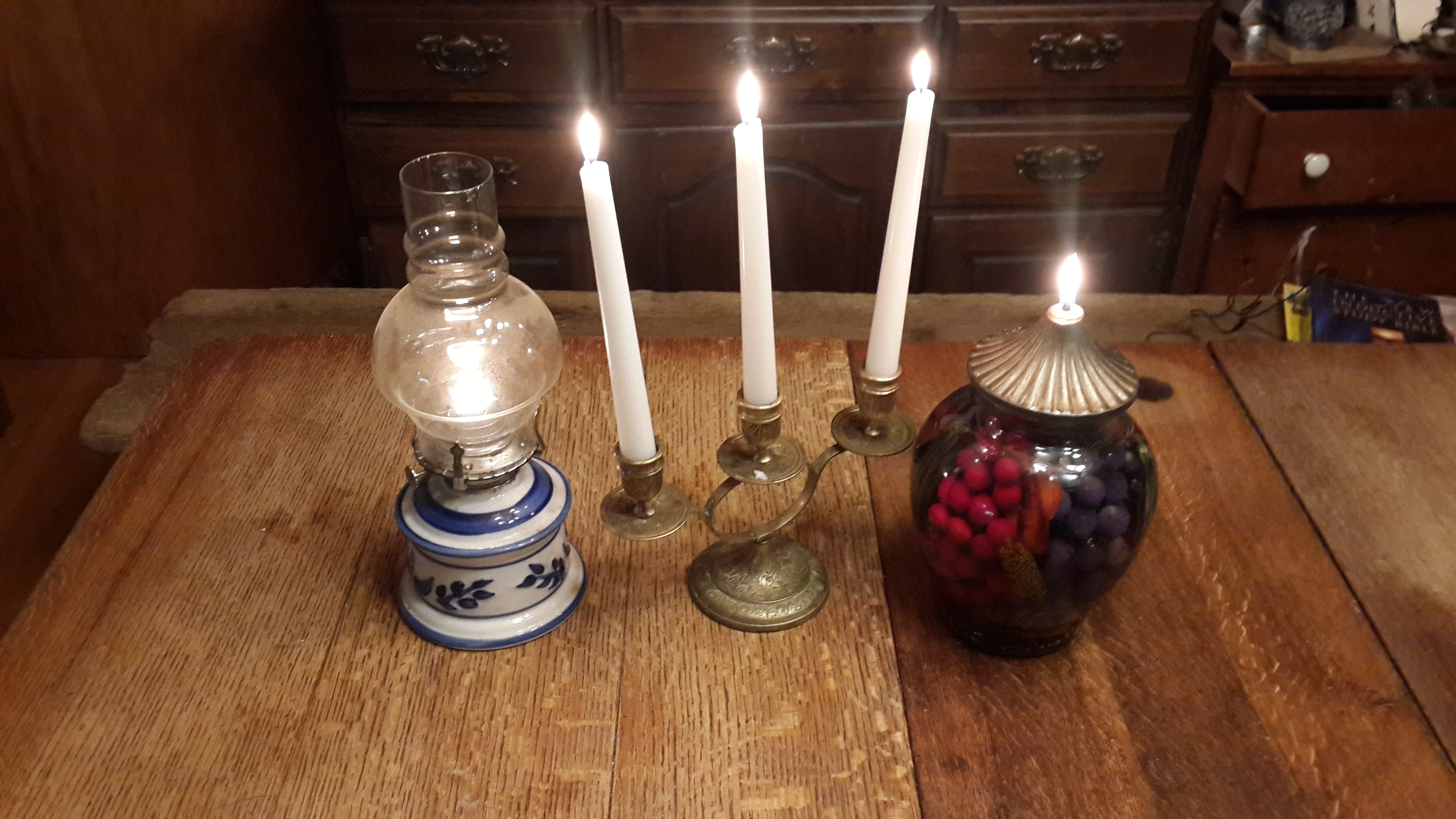
Throughout the day I continue to light candles and lamps. Now, I have electricity–I can turn on those glaring lights and I do soon enough. But I like live flame. Here are three lamps I keep on the table. Each serves a purpose.
Enlightment, Lord's Day rest, Fellowship

The first one, the oil lamp, puts out a fair amount of light, so I light that first. I feed the milling cats, light the woodstoves, water the cat fountain, and dress by this light. When the boys join me for Latin and Math later, it continues to burn. In this context it represents enlightenment. Every time we study together we light it. The flame lives in constant motion, like our thoughts as we parse our Latin sentences. It reminds me to take education seriously, theirs and mine, because in some sense our studies light a fire that will continue to burn throughout our days.

The light on the right has a colorful collection of fruits, bark, and pinecones. Smokeless lamp oil fuels the fiberglass wick. I refill it now and again. This light always burns when we are gathered together for a meal, even if we don’t have company to keep us on our best behavior. As much as we study independently, our meal times together carry extra weight, since they are usually the only time we come together. That light reminds me to draw each person out as we share our day or chew on some idea. “What do you think is the difference between philosophy and theology?” “In what way is The Tale of Two Cities about London?” “Which cat threw up in your room today?”

The middle lights, the candelabra, signify for us the beginning of the Lord’s Day. We used to do this every week, sharing a fresh loaf of braided bread and putting out the nicest dishes. Lately I have revived at least the lights; going gluten free has taken challah off the table. (Boo hoo.) We have created a little ceremony to light them.

Someone lights the first light and says, “This candle represents Creation.” We recite, “In the beginning the Lord said, ‘Let there be light'”.  [Genesis 1:3]

The next candle is lit and the lighter says, “This candle represents Redemption.” Response: “Jesus said, ‘I am the light of the world.'” [John 8:12]

The last candle: “This candle represents Sanctification.” “You were formerly darkness, but now you are Light in the Lord; walk as children of Light.” [Ephesians 5:8]

And that, my friends, is the three-part foundation of every worldview. Every comprehensive philosophy seeks to answer, “How did we begin? Why are things so bad and what can save us? How should we live?”

I fight depression in the winter. Ho hum. Nothing startling in that; I have yet to meet someone who stays perky. I think a lot about darkness, and of the strange qualities of light. Darkness cannot wrap its leathery wings around light and quench it; darkness cannot comprehend light. Like love over hatred, kindness over cruelty, light conquers darkness.

As I type this, the librarians are starting to turn out the lights and so gently chase out the lingering patrons.

May you always have the light for which your soul yearns.

Good night.
Posted in Healthy Living, writing101 | Tagged , | 2 Comments

Dear Beatrice, from Aunt Grace

Dear Beatrice,

Someone deeply hurt you in the past and now you keep everyone back with sharp repartee. You keep your emotions tightly controlled behind a prickly exterior. Your wit pricks–and sometimes spikes–your audience. You would rather set them laughing than have them show pity or sympathy. I can see you are determined never to be hurt again.

Whenever Benedick visits, my dear, you come alive. Around my brother-in-law and cousin your conversation is just enough to keep them from getting maudlin or dull. However, for Benedick you become animated and your tongue is quicksilver. Now, hear me out, my darling niece, I haven’t finished yet. I am just telling you what I observed at my last extended visit.

I think you enjoy your banter with Benedick. I am quite sure you count him a worthy opponent, someone rare who can give you back tit for tat. You know, I think you are angry with men. You think they are weak. No one is strong enough or bold enough to hold meaningful conversation with you; in fact, they are afraid of you, and you despise them for it. Isn’t this so?

Only Benedick has the wits and the boldness to fight back. It is exciting to argue with him, isn’t it? Believe me, it is richly entertaining for us, too. We’re all used to it, and in fact, when you are focused on him it gives us a brief respite. I know my brother-in-law is nervous around you, never quite sure where your words will hit next.

Benedick is charming, in a play-boy kind of way, not quite as mature as one would hope for a man of his age. Does it disappoint you when he suddenly backs down from a fight and walks off? Would that he had the stamina to continue, but you have to admit you are awfully hard on him.

You told me once that I was the only one you knew who could see the truth and wasn’t afraid to speak it plainly. Now I am telling you not to despair. Benedick is not as indifferent as you may think. Notice he is the only one who fights back, not merely humoring you or thinking you an amusing oddity. He respects you. I think he even loves you, though he may not recognize it yet. And, admit it–you are hard on him.

I foresee a time when he must choose between hanging out with his buddies and committing to the woman he loves. If he shows signs of it in your company, hold him to it. Don’t let him straddle two worlds. Give him courage to be the man he is meant to be.

May he have eyes to see the rare jewel before him (for so you are, my dear). And may he, in turn, heal your heart with trustworthiness and lively companionship.

In deep affection,

Aunt Grace

Author’s note: This is in response to the WordPress Writing101 Day #8 prompt, “Write your post as a letter”.

Posted in writing101 | Tagged , , , | Leave a comment

Windows for Writers

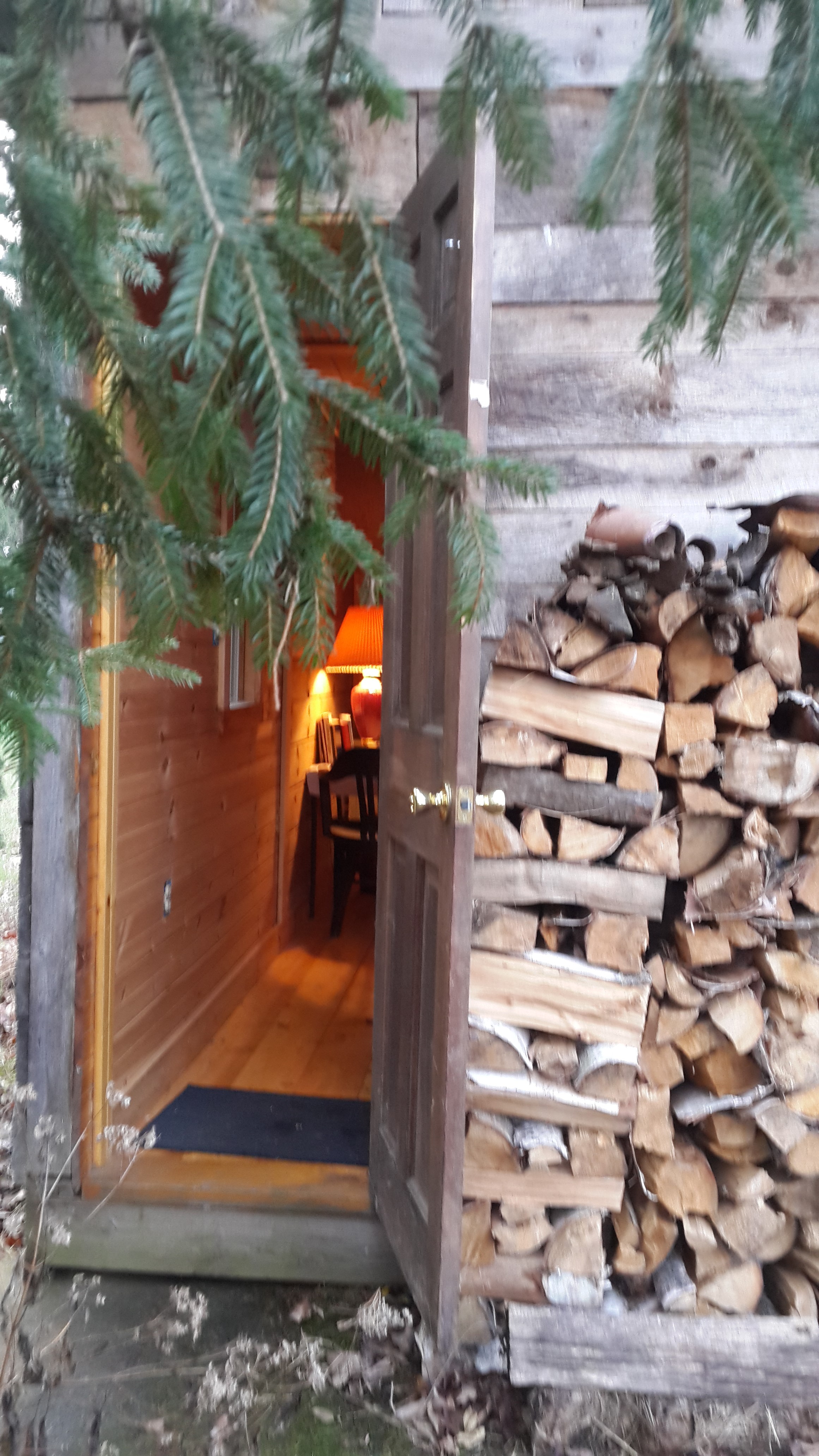
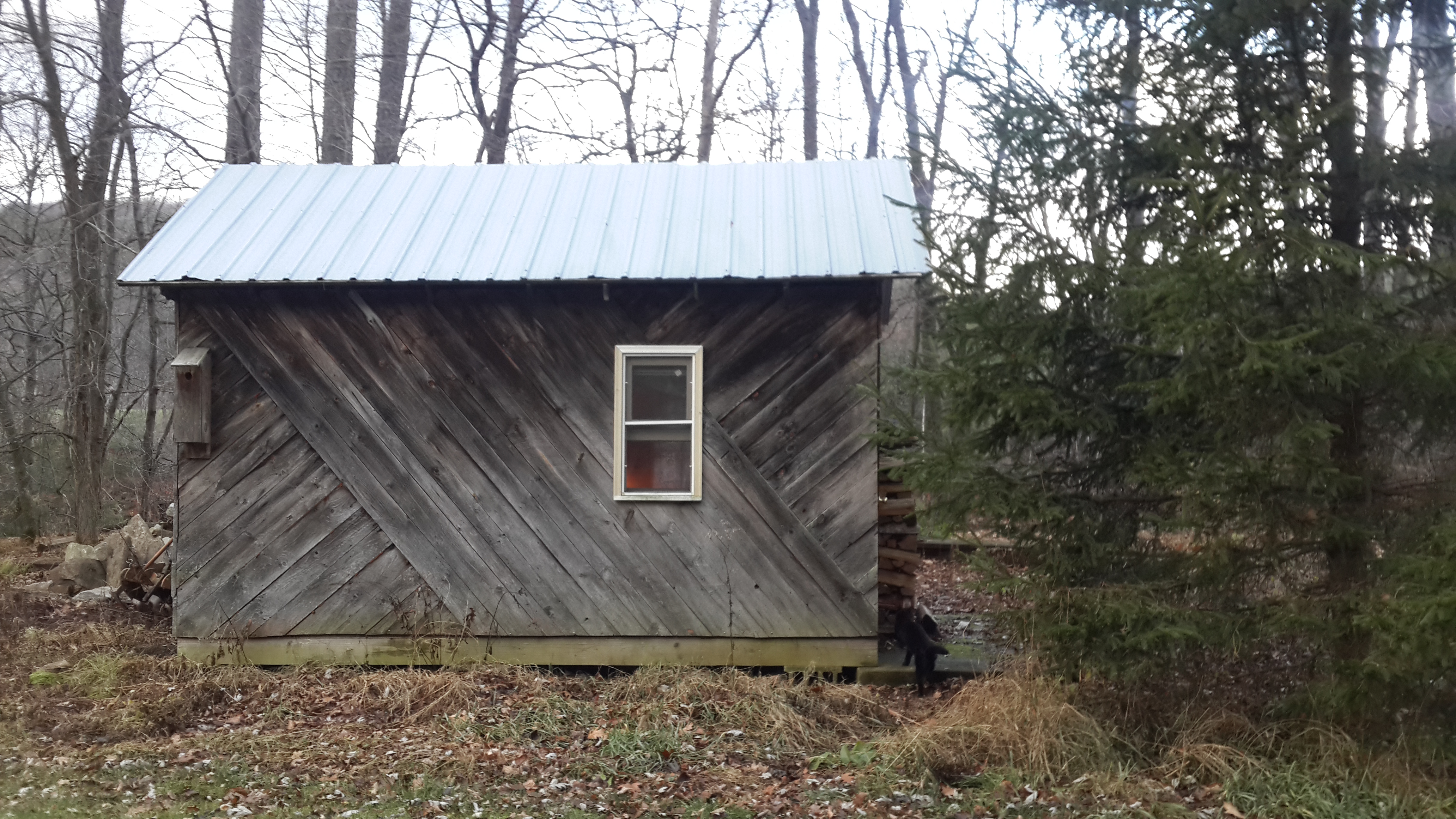
We have a cabin out along the back of the property, overlooking the river.

20151113_080458

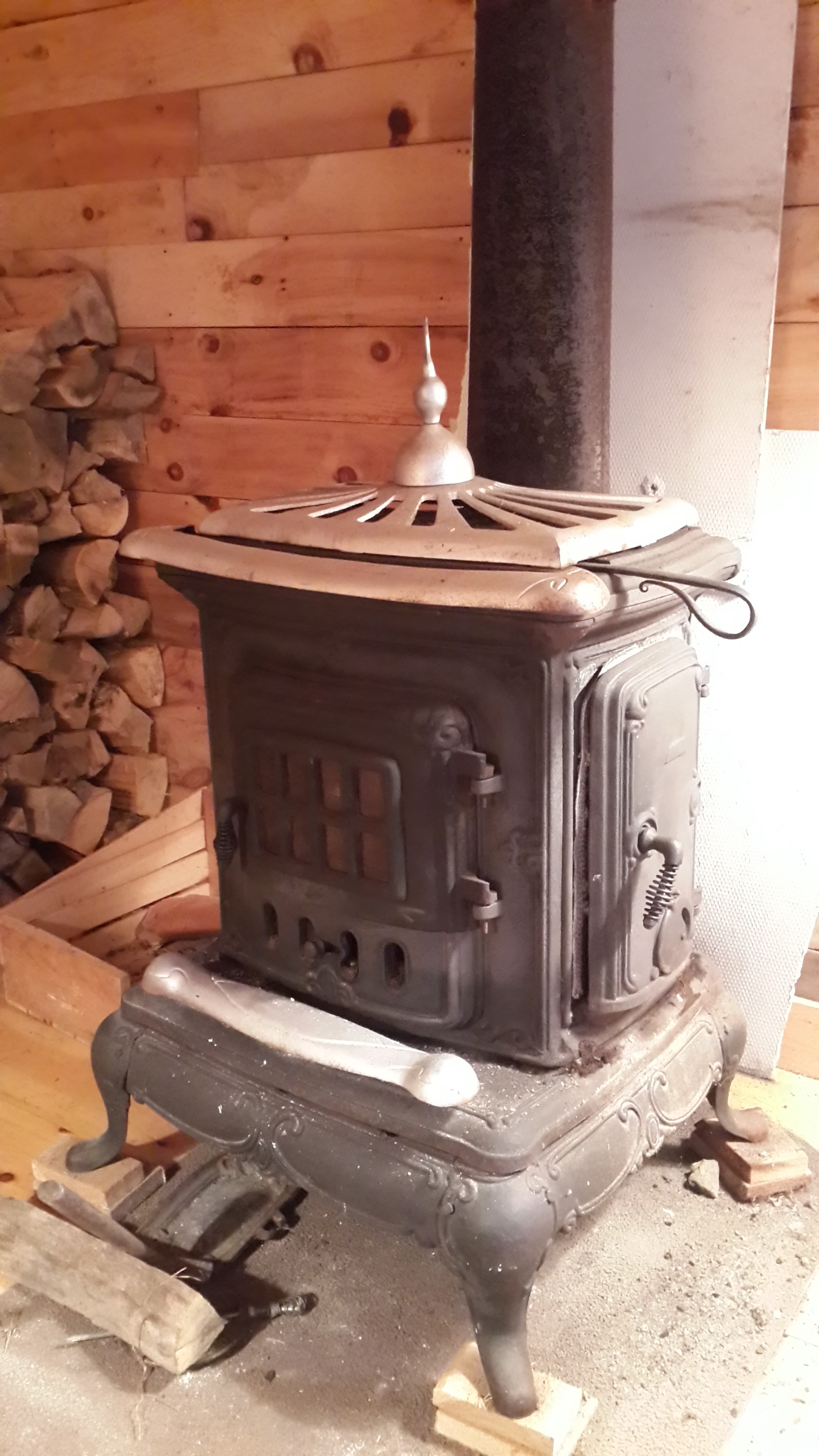
We offer it to company of the more adventurous sort, but I also use it as a retreat in the fall when, like Ratty, I feel restless and want to break away from the clutter that ties me to my daily grind. On those nights I carry a basket with matches, canned milk, oatmeal and a pan, water, and tea, so I can rise early for breakfast and writing before I return to the big house for homeschool lessons. I keep the old woodstove going through the night so that in the morning I can put on a kettle for tea and a pan for oatmeal. That aluminum heat radiator comes off.

20151113_080645

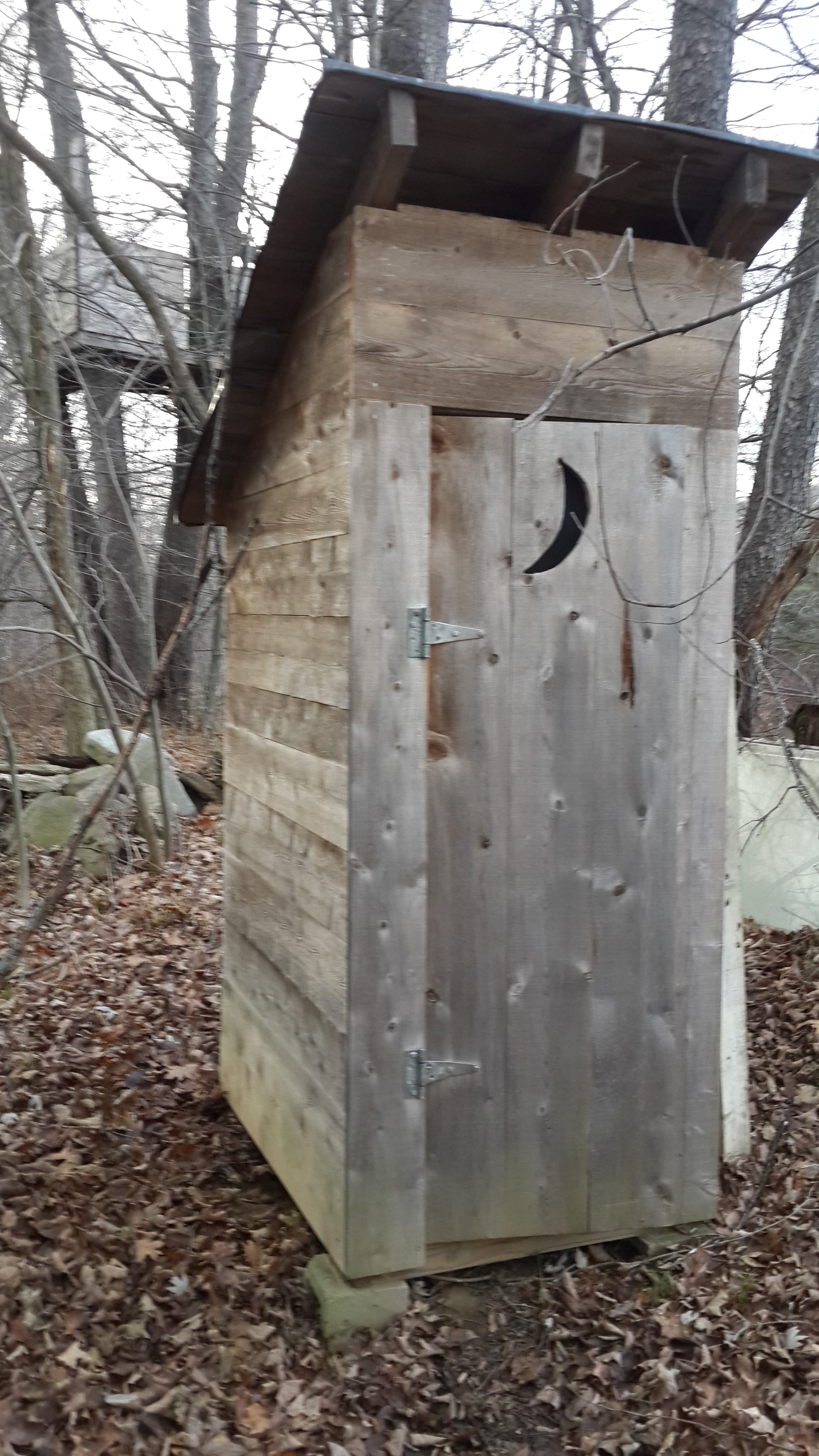
It has electricity but can’t quite catch the wireless, and that is a good thing. It has no water but it does have an outhouse.

20151113_080600

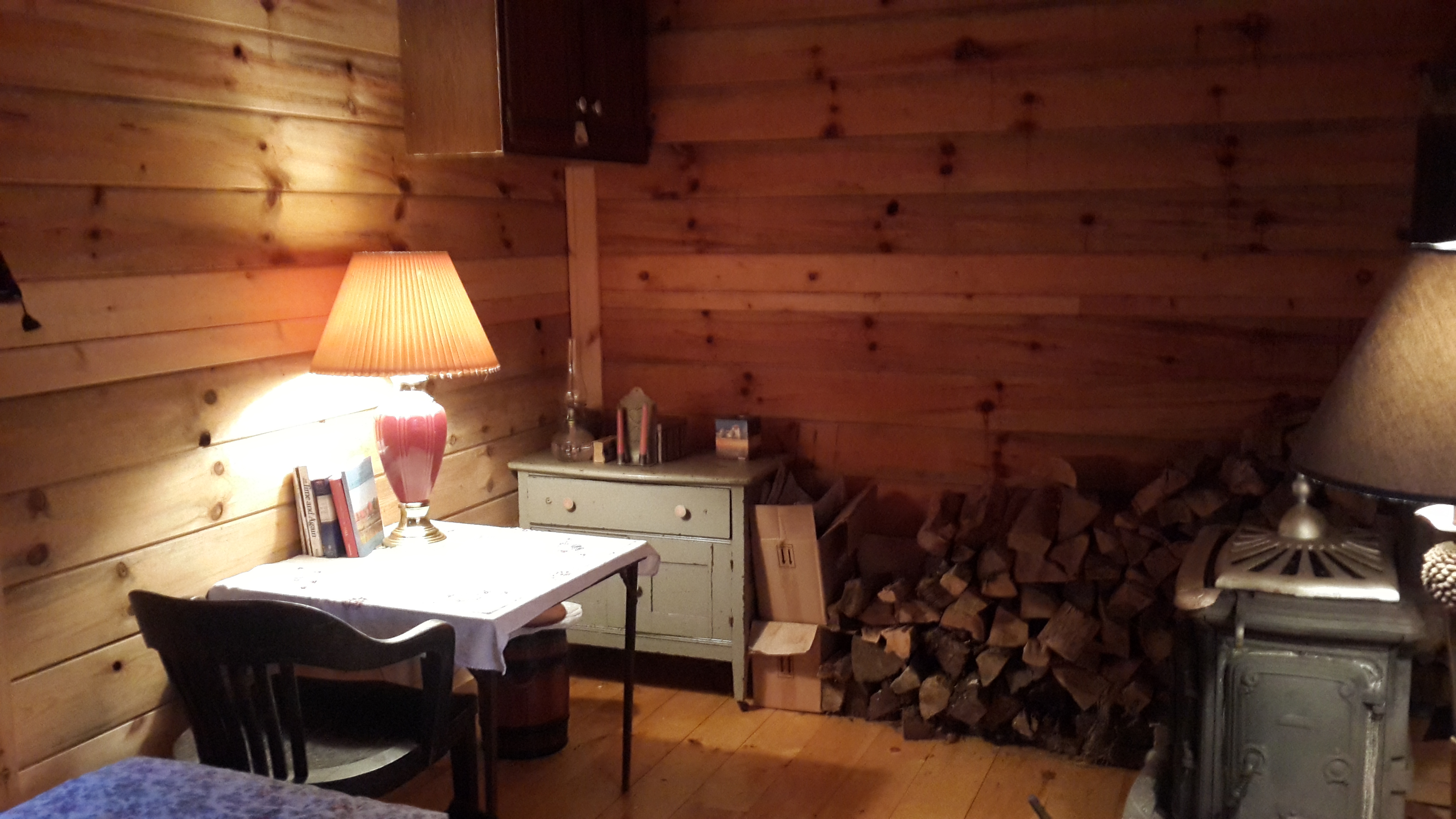
I write out here when I can but I have to say I don’t like how dark it is. Simple, uncluttered, yes. Remote, yes, yes. But something in me requires an open view, a portal beyond my box, which, now that I  think about it, is a perfect metaphor for the creative act of writing. Here is what I have. Lovely, isn’t it?

20151113_080740

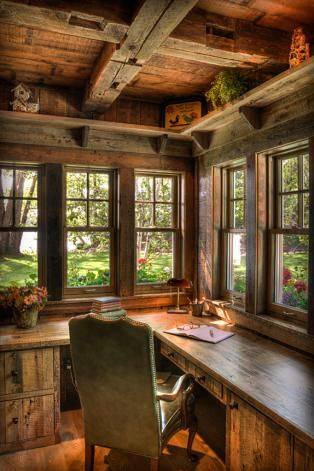
I saw this image on Facebook and do not know to whom to credit it. This is what I would like, and Bob the Builder says it would be fairly easy to put windows in that back wall.

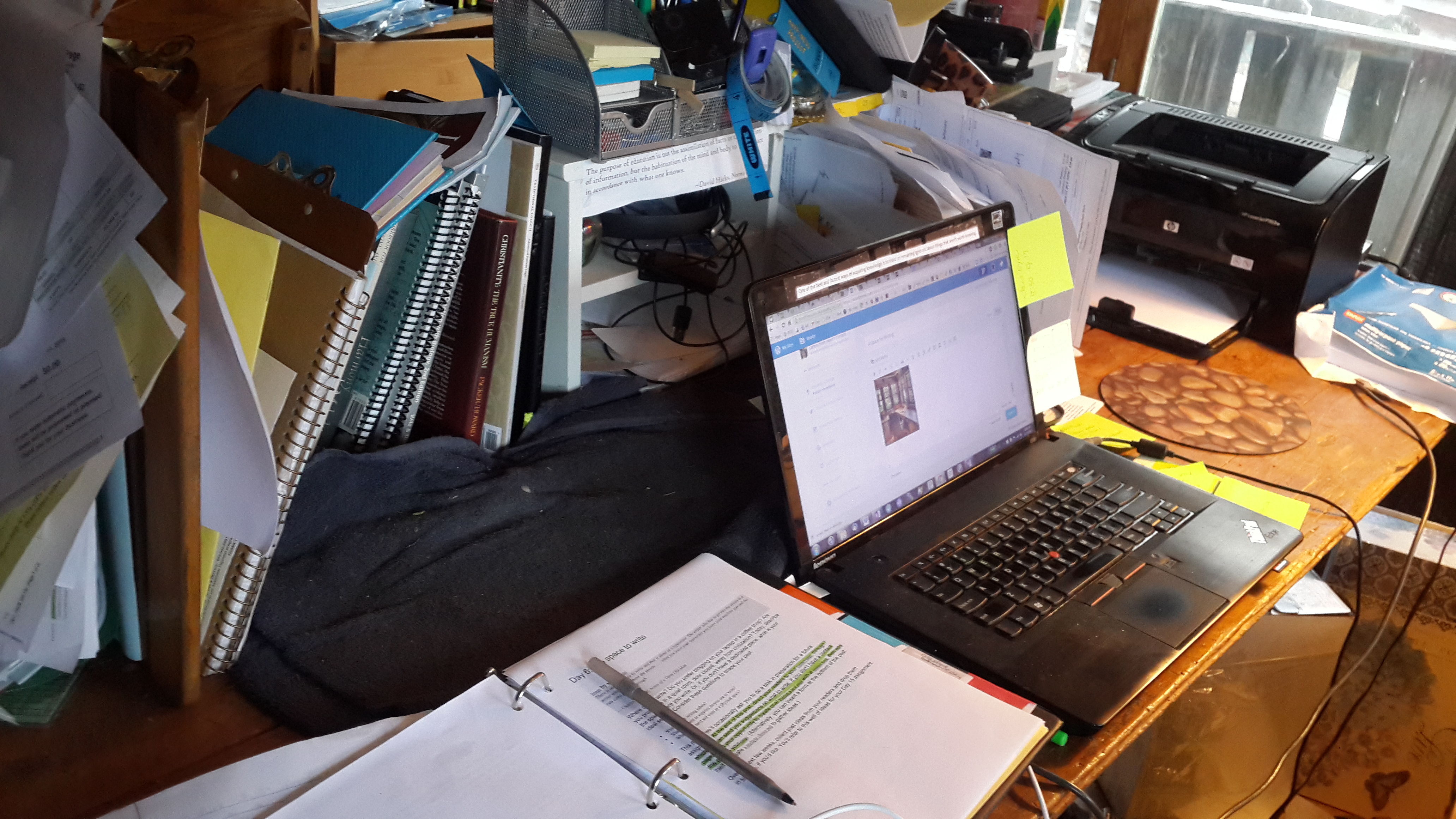
writers desk in cabin

This is how my desk looks now.

20151113_082623

Since this is also Command Central, where I handle the family’s bills, college search, school planning, Grandpa’s paperwork etc, papers abound and I can always find something I should be doing beside writing. The cabin retreat makes sense.

For November I have joined the WordPress Writing 101 class, which posts daily prompts. I write when I can, getting up early in order to be done before the boys and I work on our Latin lesson at 9:00.

The act of writing teaches us; vague thoughts coalesce into something new and unexpected. This assignment opens my eyes to the beauty of that cabin as a regular writer’s retreat. It means making a fire early to warm the place up but the men in my life have stacked me quite a pile. I have all I need, windows or no windows. After all, writing is a deeply internal activity, and every writer knows how to see through portals into the vast universe of the writer’s soul.

20151113_080535

Today’s prompt also asks me to link to my contact page and ask for suggestions on what to write. Have an idea for me? A challenge? Something you would like to know more about? post in the comments or go to the Contact Page, linked at the top next to About.

Posted in Writing about writing, writing101 | Tagged , , , | 12 Comments

Black and White

Back when Robbo and I were new parents, I used to host poetry parties.  I believed life was more than work, food, and sleep, and that our souls needed to be fed on poetry in the company of good friends. I asked everyone to bring a poem, but I memorized mine. “The Onset” by Robert Frost captured my dread as we fell inexorably into winter like a spacecraft into a black hole.  Overly dramatic?  You think I may be exaggerating?  For me depression and shorter days pair like stupidity and lack of sleep. Do not look at Quickbooks entries made after 11 pm, and after November 1st do not look for my sunny countenance. I have packed it off to take a long rest.

Notice what Frost does so well: his detail makes us take notice of what we have experienced so incompletely, and he draws us to think about more than what our senses tell us.  Frost never reduces reality to empirical data; he doesn’t simply describe.  Reality is always more, he says; everything has meaning. His is a personal universe. The first verse is bleak with an apt description of that dark day when the first big storm of the season is nearly here.  Yes, winter (or for that matter the news lately) sucks from me my life and courage, making me question if I am making any difference to anyone. Winter is a shadow of the future that comes to every one of us, and it whispers that nothing I do endures, just as the frozen gardens and naked trees have nothing to show for their summer’s work.

And then that lovely turn in the word “Yet”. Oh, my–this means so much more to me twenty years after I first learned it.  I have over 50 years of experience with spring after winter, joy after tears, hope after despair.  I am not sure if Frost’s last line is just a handy rhyme for “birch”, or if he, quietly and without banners waving, nods to the necessity of faith in God. Though he brings up the village and its church last, I think I will look to them earlier, and beat back the isolation of winter with warm fellowship, fine food, and poetry.

The Onset

By Robert Frost

Always the same, when on a fated night
At last the gathered snow lets down as white
As may be in dark woods, and with a song
It shall not make again all winter long
Of hissing on the yet uncovered ground,
I almost stumble looking up and round,
As one who overtaken by the end
Gives up his errand, and lets death descend
Upon him where he is, with nothing done
To evil, no important triumph won,
More than if life had never been begun.

Yet all the precedent is on my side:
I know that winter death has never tried
The earth but it has failed: the snow may heap
In long storms an undrifted four feet deep
As measured again maple, birch, and oak,
It cannot check the peeper’s silver croak;
And I shall see the snow all go down hill
In water of a slender April rill
That flashes tail through last year’s withered brake
And dead weeds, like a disappearing snake.
Nothing will be left white but here a birch,
And there a clump of houses with a church.

Posted in Literature, Poetry, Stories of Home, Writing about writing | Tagged , , , , , , , , | Leave a comment

Epiphany at the Museum of Fine Arts in Boston

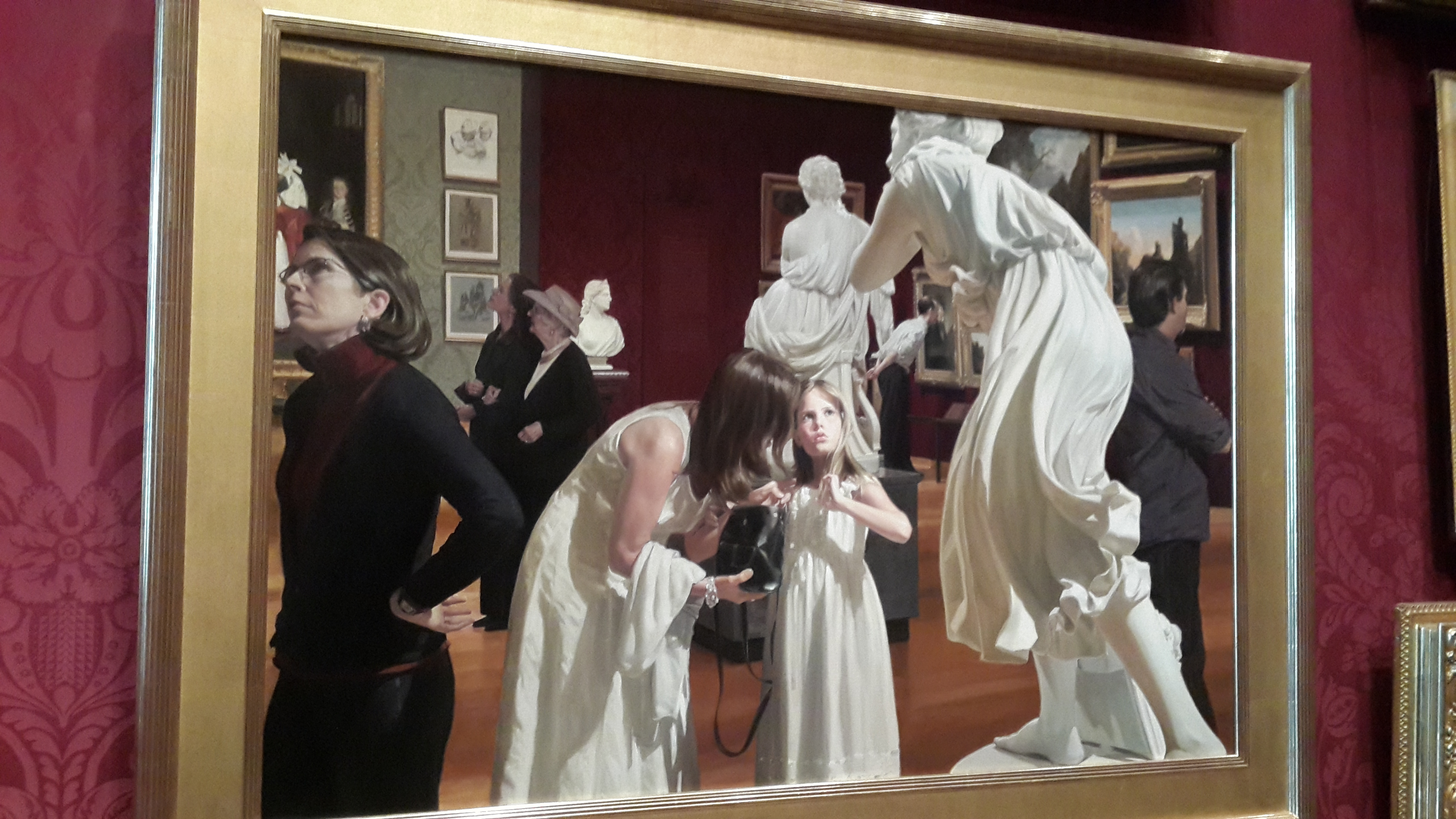
Yesterday at the Museum of Fine Arts in Boston I stood before this painting more than any other. It is called Museum Epiphany III by Warren Prosperi (2012).

Museum Epiphany III

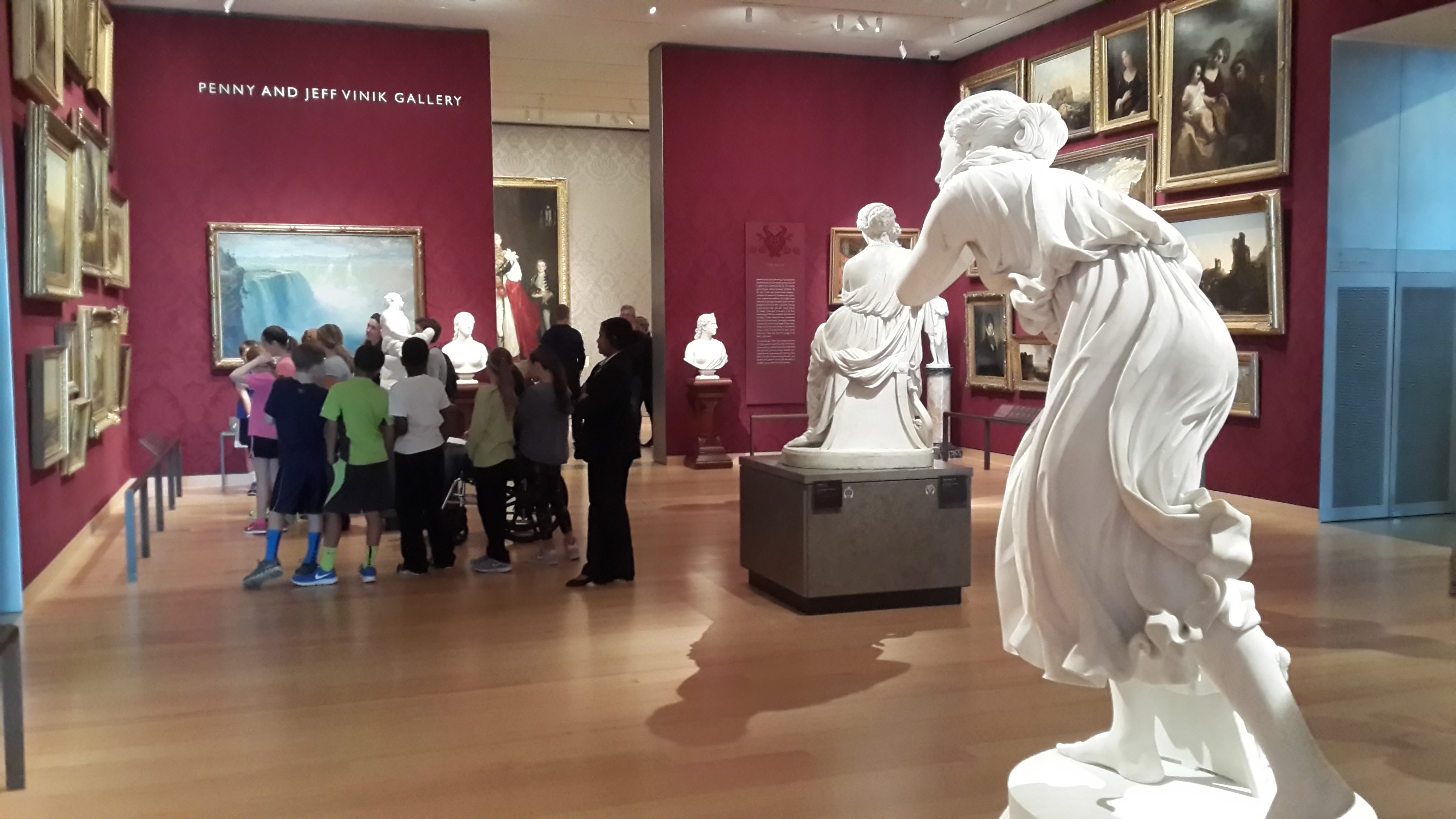
It didn’t take me long to realize the painting, the only modern one in this American Art gallery, was set in this very room. In fact, the first thing I did was locate the artist’s view point.

Museum epiphany iii MFA

The next thing I did was to see what the girl saw.

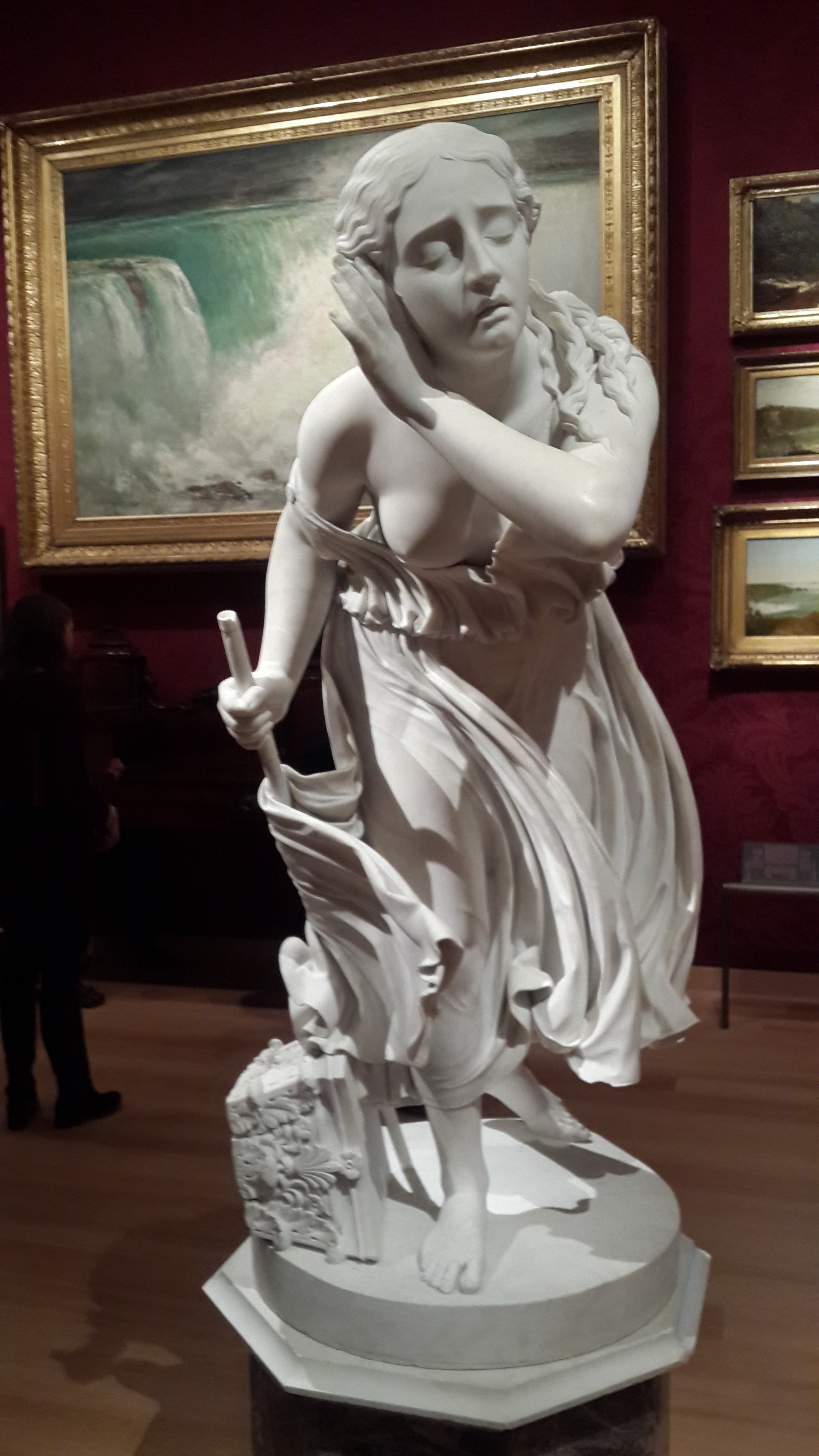
statue

Nydia, The Blind Flower Girl of Pompeii

When you look closely at the painting you see, through her hair, the mother’s lips as she whispers to her daughter. Perhaps she tells her daughter the story of The Blind Girl. The daughter is arrested in a absent-minded gesture, fingers combing her hair. Perhaps the woman on the left overhears the conversation, whose ear is uncovered by hair and seems to be highlighted by the artist. Both the central figures wear flowing white, the artist illustrating how art can draw us in, making us identify with the maker.

Each of the figures in the painting engages with the museum art on some level. I saw all kinds yesterday myself: artists standing before a piece and copying, school kids flocking from room to room with guide in tow, people moving briskly through a room to get to something beyond, and individuals who stood long and quietly before one piece of work. I did all those myself, as I was visiting with the Challenge II class and with my soon-to-be-art-student-in-college daughter who had her sketch book with her.

After three hours I was mentally fatigued. I want to go back with Sylvia, who hopes to attend art college next fall. And I don’t even mind Boston, quirky city, as long as I have a navigator beside me.

And now we can all say we have been to Boston in the fall.

Posted in Art, Classical Conversations, writing101 | Tagged , , , , | Leave a comment

Why Winter is the Best Season Ever

Let me be honest about this. Winter is the best in the same way black and white TV is better than color, or finding the bones of a flying squirrel is better than seeing a live one.

However, over the years I have, out of desperation, discovered the many unique benefits of a northern winter. When I moved to Vermont in February of 1988 to marry my childhood sweetheart, I had been living in Maryland, where spring comes early and autumn lingers. After the first harsh winter took forever to dissolve into spring, I suspected, but then in chilly August knew, that the summer cycle ran short. I dreaded winter, even though as a child in Connecticut I had loved it.

I decided to make a list of its blessings because, as we all discover, surviving winter without crashing into serious grumps is a mind game. Here then is my list:

  • No bugs. If your skin crawls, it needs moisturizer, not a slap.
  • We can see and appreciate the bones of the landscape: her features hidden behind the summer crop of leaves. Tree species have unique shapes and growing patterns. Also, the terrain is now visible through them. In Vermont’s wrinkled geography, that means our view is no longer blocked by the trees along the valley road, and we can see far into the woods on either side. In winter we get to use our distance vision.
  • Thanksgiving, Christmas, and New Year’s make early winter fizz and bubble. It isn’t until mid-January, after I recover from all the excitement that I wake up and realize winter has clenched us in a stone fist and is now my enemy.
  • We start to get more light after January. A story: Last year my husband and I sat at the table with the sunrise-sunset time for January. We pored over it. It doesn’t matter that solstice occurs in the third week of December. We saw that for three weeks at the turn of the year the sunrise time just. barely. budged. Sunset was little better. We combed the data for a glimmer of hope (cough). The shortest days, 8 hours and 58 minutes, are from December 18-26. We make slow progress, gaining a minute on both ends here and there. But in February, if you can believe it, we get noticeable improvement.
  • Snow covers the death of summer, its leaves, stalks, and fallen branches, with a clean white blanket. Always makes me think of my sins being covered by God’s forgiveness through Christ. Psalm 51 and Isaiah 1:18. Clean snow reflects light; snowy winters are not as dark.
  • Winter comfort foods. Stew, soups, cornbread, gingerbread, baked apple, baked acorn squash and sausage, frozen kale from the garden (it’s sweeter after frost), Brussels sprouts dug from the snow, hot oatmeal for breakfast, waffles, muffins with pumpkin pie spice, mulled cider, hot chocolate. Not to mention all the foods specific to the holidays. I like to start a stew and leave it to simmer on a woodstove while we study and do chores.
  • Fires in the woodstove. Not everyone has this blessing so I hesitate to bring it up. This is the only time of year we can come in chilled and draw close to a heat source to get relief. You get baked on one side as you stand as close as you dare, then rotate to toast all over. Lovely. My one stove with a window has the charm of live flame.
  • Hospitality. Through the summer we need our Saturdays to get projects done, and privately grumble about Saturday invitations. In the winter everyone knows the warmth of fellowship at someone’s house is worth the drive in the dark and bitter cold. In winter we even do this midweek. We’re that hungry for new voices.
  • Music. Desperation for something to beat back the cabin fever makes our amateur music skills suddenly seem like an asset and not a liability. We jam and don’t care how it sounds. (The windows are closed.) Folk songs and contradance music for us. Christmas songs in season.
  • Big progress in school work. There is nothing else to do.
  • Snow fall. I’ll grant you, this means different things to different people. When I am looking at falling snow from the comfort of a warm parlor, I am not fighting my way through it on a road trip, or working in the woods, or figuring out how I am going to fit plowing into my schedule.
  • Books. With the garden put to bed and cabin life short on novelty, we find this is the best season for reading aloud.

There. Now I am looking forward to it! This morning I notice all the leaves have been pulled off our riverbank trees by yesterday’s strong winds. Stick season is here. And it is okay.

What do you find special about winter? Add to the list in the comments below.

Posted in Stories of Home, writing101 | Tagged , , | 2 Comments

Gold threads

If you were to ask me why I keep a blog, I might answer with one of these:

1. The art of crafting an interesting post redeems a day spent on work. I know my day’s labor has long-lasting meaning–educating my kids, providing nutritious meals, managing the household expenses, providing hospitality–but I find it deeply satisfying to create art in the crevices of my duties. When I finish and click Publish, I know I have made something uniquely mine, and for a couple of hours I feel like the cat that finally knocked over the fishbowl and ate the tetra. Cocky. Full. Ready for a nap.

2. The idea that I have my own space in the mysterious internet universe tickles me. And I am a sucker for shiny. I love the back window of my WordPress blog, with its tools and stats and place to store drafts. When a post draws comments, I experience a kind of awe that my soul touched another’s. The backlit blank screen draws me like moth to flame. I want to put something on it and see it posted under my header picture. Voila! I am published!

3. On a good day, words pull from mind to fingers in a smooth thread, like the straw turned into gold by Rumpelstiltskin. I love that. What an antidote to a fragmented day, where as the homemaker-homeschool teacher I answer to interruptions constantly.

4. My childhood was shaped by books. I used to read all the time, lounging on my bed or sneaking away to read in the woods. I still read, holding a book while work at chores when I can get away with it. I love the taste of wordplay, and apt analogies are filet mignon and roasted brussels sprouts. (You can nourish me with ground beef and potatoes, but they don’t create that kind of pleasure.) I love an excellent meal of words and want to try my hand at cooking for myself.

5. Last, I write because odd connections occur to me and I want to share them. For instance, this month during the most fabulous foliage display I have ever seen, I noticed how the yellow stripe down the middle of the road contained the same colors as its surroundings. All year long it is a glaring anomaly, deliberately artificial, painted to get our attention and keep us out of the way of danger. We live are forced to live by yellow lines in a green world. Rousseau would hate to drive by this unnatural construct, resenting the restriction this places on natural man. [This is supposing he would submit to the rules of the road long enough to get a driver’s license.] We are not free to drive as we might; the law of the paint restrains us.

But look! At the end of the summer, gradually the green fades and we discover the world that was there all along: the red, yellow, and orange that were masked by the green of photosynthesis. And one day we realize the yellow stripe is in perfect harmony with this marvelous new world.

Yellow stripe in foliage season

Likewise, I am quite sure we will discover, to our delight or horror, that the universal, transcendent moral law that chafes us so much now will fit perfectly the world we are born into after death. Is it hard for me to love God now with a whole heart? Do I find it difficult to love others unconditionally? To be honest in all my private dealings? Does the moral law seem artificial to me now? I look forward to the place where it all fits.

Meanwhile, I hope to spin a mountain of straw-thoughts into a thin line of gold, making some sense of what I experience in this green world.

Posted in writing101 | 3 Comments

Thornton Wilder’s Our Town Bugs Me

Cora Koop and I attended the production of Our Town at Northern Stage in White River Junction, Vermont this week. Excellent production; top tier directing and acting. If at all possible, see it before its final performance, October 31, 2015. Someday you may be proud to say you saw the first production in the new theater building.

This was the third time I have seen this play since high school and I can see why it is the most produced play in America. In many ways it resembles It’s a Wonderful Life, particularly in the sense that is looks at the whole arc of life and says there is more to life than our day to day activity. But while Our Town surpasses Wonderful Life in literary quality and artistry, I find it oddly disappointing. The Third Act has both touching insight and deplorable blindness.

First, a quick overview. He uses the character of Stage Manager, who breaks the Fourth Wall, to narrate, make commentary, and draw us into the life of Grover’s Corner. In the title, Our Town, Wilder intends for us to include ourselves in the ordinary events. We too grew up as a child, in time created our own home, and live in the shadow of our death to come. Thornton Wilder’s writing simply dazzles me. Honestly, I was captivated from the first word to the last. No wonder this play won the Pulitzer. You must see this play!

But every time I see the third act I come away feeling Wilder didn’t quite get it right. Mind you, by the end my face is wet with tears; I don’t deny it. It is his portrayal of death after life that bugs me.

So, Act 3 features a character who has died. She takes her place in the cemetery, stark rows of folding chairs in which several people sit quietly, like the tombstones they resemble. She is new and is still full of thoughts of her life at home, but for them the fires of life have banked down; their voices have lost all passion. They are detached from earthly life and existing in some kind of suspended time, waiting interminably for something never mentioned. I suppose that is how a cemetery strikes us. After the woman goes back to visit an ordinary day of life, she grieves at how little humans appreciate life as they live it, and disgusted with herself she returns to the hillside resigned to leave behind earthly life.

Now, I do appreciate Wilder’s insights. He has her say,

“It goes by so fast. We don’t have time to look at one another.”

“Live people don’t understand, do they?….They’re sort of shut up in little boxes, aren’t they?”

Woman: “Do any human beings ever realize life while they live it? –every, every minute?”

Stage Manager: “No.” (Pause) “The saints and the poets maybe, they do some.”

Seriously, it would be madness to be hyper-aware of “every, every minute”. We are out our absolute best when we are self-forgetful in our living and giving, as was George Bailey doing a simple kindness to Violet, whose kiss leaves a mark on his cheek. But Wilder’s point of living with joy and appreciation is well taken.

No, what irritates me is how he portrays the move from life to death. Their growing indifference to life–what is that about? Within a Christian context–the dead are waiting in the cemetery for the resurrection of the body–he portrays a wholly unChristian concept.

If death is such as he portrays it, what point is there to life? Has he given his audience a reason to live better or to have joy in ordinary moments? By this stark death there is no hope, and no meaning to life. It is little better than the existentialist’s “take control of your life and live it to the fullest because it has no meaning otherwise,” and there are no truly joyful disciples of that school. Without hope for something to come, something that makes sense of our lifestory, life is ultimately meaningless. “Enjoy every moment” sounds good, but without hope it can’t be sustained.

Wilder talks around the huge Presence in the room. The good news (gospel) is that Christ burst the wall between life and heaven, so that those who come through Him, the door, continue to live but now fully alive. In Wonderful Life George sees the effect his life has on the community and though it is not a vision of eternity, even that is enough to give him joy and gratitude and with it vitality for the rest of the road. The Christian has even more, for she knows her life began through her Creator, continues through His sovereign over-sight, and will end with her Savior who is her door into eternal life. Christ makes the difference between empty-life-empty-death and a life lived in a meaningful trajectory that goes beyond death into eternal life.

I love this play and I would see it again this week if I could. Wilder tells us we are going to die so all we can do is appreciate life while we can. The gospel of Christ tells us our present life is a dress rehearsal for the next so play it with joy and look forward to our entry into the life that is played out forever.

Posted in Art, Literature | Tagged , , , , | 2 Comments

All Shall be Well

Those of you who knew pastor Norm Koop know why we grieve so deeply. He was a vigorous, dynamic man, an excellent teacher and a humble leader. You don’t often find those together; add to them a goofy sense of humor and you have a character: one who leaves an indelible imprint.

He died in foliage season, but a fallen leaf is not a good metaphor when a man of this caliber dies in the prime of life. A leaf fades and falls because its work is done. He was a prize apple tree destroyed one night by lightning.

But his death sure has stirred up a bee hive of thought. Here are some of the things I have been thinking about:

  1. Norm had ten talents and used them to return a hundred. I have two. Living and dying well comes by serving authentically with what you have. I’ll serve even if it seems small.
  2. I held back from getting to know Norm and Anne better because I didn’t want to push myself forward, to be a bother, to take up their time. And so I lost a the great gift of knowing and being known by Norm. A shame.
  3. We have been in the presence of greatness. I will not take excellence for granted again.
  4. I meditate on the Word more, reading it more often during the day. We are going to read to the family at supper time, a practice we had when the kids were little but didn’t continue, for some reason. The youngest boys and I have been slowly studying Psalm 1. This evening after supper I read aloud Boice’s commentary on Psalm 1 and we found both familiar ideas and rich expansion. And I noticed how peaceful and how right it felt to be experiencing it together. Why did we stop??
  5. I need my Christian family. The mutual sorrow and comfort of these men and women helped me and my family walk through our grief. They are so very dear to me.

I am grateful that we just happened to be on school break these two weeks, having two weeks to do one week’s worth of work. In a brain fog most days, I was glad to have the cushion of the extra days. I only wish my two college children could have been here to say farewell in person.

It is a good life, and then it gets better. “All shall be well, and all shall be well, and all manner of thing shall be well.” –Julian of Norwich

Posted in Stories of Home | Leave a comment

#TBT Oak-ay, Life is a Beech

You know how foliage glows luminously when the rising or setting sun shines behind it? I was struck with wonder at the Williams River valley as I came over the interstate bridge this late afternoon.  The flamboyant red maples are sticks now, the stately sugar maples have lost almost everything, but the oaks and beeches are in their peak, magnificent in copper and bronze. I always think of Lothlorien when the foliage takes on the appearance of precious metals.

This has become my favorite part of foliage season, and tonight I realized how much it resembles middle age.  I once had the appeal of youth, the glow and glory of good skin and lively spirits.  Now I live the mellowness beyond first flush, and the steadiness of the day’s end when the wind dies and the slanting sun is no longer harsh. I am too tired to be harsh, too content to be windy, too settled to be dancing in a flowing red skirt.

Like coins without number, the reflected glory that filled the valley speaks of the inestimable value of the faithful servants of God who persevere in their given tasks, knowing there will come a season when all they are falls to the ground in a final accounting.

Posted in Stories of Home | Tagged , , , | Leave a comment