Gift Wrapped

We all have them, those memories that make us squirm and cringe.  Whether excruciatingly embarrassing or justly condemning, we have a permanent record of some really stupid moves. Like the time I swore a blue-streak at a pretty decent guy in high school. And the time I was asked in front of thirty people to give the pith of the opening sentence of the Declaration of Independence, and I went on and on instead of saying merely: ‘Common courtesy demands we state why we are breaking away.’ (That may not seem like a big deal, but it was a blow to my pride.)

I was cutting up onions one evening just before Christmas, weeping as I do on those occasions, and working up a good reason for tears by going over the latest crop of slimy memories.  Always looking for a reason to justify the extravagance and gift-giving that marks this holiday in my home, I made a fabulous connection.

Those experiences are gifts from God. Under the sovereignty of God each one of those experiences was foreordained, even crafted, for my benefit.  He makes no waste; even my sins and gaucheries work to sanctify me, to answer my heart’s desire to have more of the character of His Son. Each indiscretion is an answer to prayer for wisdom. Each one modified my behavior at least a little; I don’t repeat my ‘mistakes’ because the memory of the first burns so much.  And certainly the remembrance of my own failings gives me compassion for those whom I witness in theirs.

I will never see the gifts under the Christmas tree in the same way.

Posted in Stories of Home | Tagged , | Leave a comment

Taking the Challenge

All right, I’m going for it.  My goal is to post at least once a week. I am taking the Word Press challenge to write regularly. That was my goal all along, but I have been hindered by the sense that I have to write a well-crafted piece.  Maybe I could just write small ideas instead of working on big ones? Y’think?

Posted in Writing about writing | Tagged | 3 Comments

Dappled Days; Home for Thanksgiving

This Thanksgiving we traveled to Mom-and-Dad’s.  For a few years we have been having Thanksgiving here in Vermont, and her home makes mine feel like a rustic log cabin (which it basically is). We watched How to Train a Dragon on their new flat screen TV, with those sub-sonic rumblings coming from movie-theater speakers. We felt very welcome there, and everyone outdid the next guy trying to get Grandpa Green to laugh. Hands down, he is the quirkiest, funniest one of the bunch.

On Friday morning I took some kids with me to visit their Aunt Cindy, my sister, who has come to the Lord in the past seven or so years.  We have been estranged for most of our life, but now we share the love of the Lord.  I have been to her house no more than three times, I think, in 25 years. The kids hardly know her, but they connected this summer at a surprise party for our Aunt Mary. Cindy was obviously surprised and interested by them then, and has kept up emails since. I am tickled; I wonder if she remembers telling me (13 years ago) not to bring them back till they were teens?

She never had kids, but boy, does she know how to entertain them!  She dazzled mine. She was clever, perky, zany, delightful, frank, fascinating. I was pretty quiet; we didn’t get to visit, just the two of us, because she was focused on them, but I felt a sinking in my heart as we played table games and watched her engage my kids.  I used to be funny, perky, nimble-minded; now I am slow and heavy.  I coveted her clean, tidy house, and the companionship with her husband, evidenced by their daily cribbage games. My house is dusty and cluttered, and Robbo and I don’t seem to have time for fun right now.  She prays big things from God and bubbles over in confident zeal.

Later, when I got a chance to process it all, I began to realize a) I carry a heavy burden that she does not. By God’s training I have become sober and careful, as I need to be. I lay down my life in order to train these children.  b) I think she has the gift of faith, expecting large answers, and visionaries like this tend not to have much understanding for the place of suffering in the Christian’s life.   c) My house won’t always be crowded with homeschool stuff and things I don’t have time to sort.  d) Robbo and I will eventually have a new relationship in retirement. All in His time.

One thing I realized when I was with my family is I really have always been an abstract thinker among concrete do-ers.  A pretty funny moment: Mom pulled out a box of cards after conversations lagged one afternoon. I think I had two kids with me at the table where I was copying recipes.  She directed her first question to me: “Which is more important, to develop beliefs, or to gain knowledge?” I paused for thought, and then began. First I defined ‘beliefs’ and ‘knowledge’ and then gave my thesis, “I believe beliefs are more important.” Then I took it further, suggesting a pursuit of knowledge is best founded on knowing God. I gave support for my argument, quoting Proverbs “The fear of the Lord is the beginning of knowledge”.  I took a breath to go on, but she pulled another card and turned to ask Abe something.  I smiled.  There I go again, talking more than anyone wants to hear.  I never did fit in, in some sense, and that is all right. I love these people; they are my own. But I praise my Father for placing in my life friends and fellow-tutors who get jazzed by exploring ideas in conversation or blog.

After supper my kids stood to recite. They gave a speech by Winston Churchill, one by Calvin Coolidge, Jabberwocky, The Charge of the Light Brigade, and The Common Cormorant or Shag, and I recited Pied Beauty by Gerard Manley Hopkins. It says, in part, “…All things counter, original, spare, strange…He fathers-forth whose beauty is past change. Praise Him.”

How entirely, serendipititiously appropriate.

Posted in Stories of Home | Leave a comment

What Incompatibility?

In my opinion, it is not possible for religion to find a set of metaphysical ideas which will be guaranteed not to get into conflicts with an ever advancing and always changing science which is going into an unknown.  We don’t know how to answer the questions; it is impossible to find an answer which someday will not be found to be wrong.  The difficulty arises because science and religion are both trying to answer questions in the same realm here. Dr Richard Feynman, from “The Relation of Science and Religion”, a transcript of a talk given at the Caltech YMCA Lunch Forum on May 2, 1956. http://calteches.library.caltech.edu/49/2/Religion.htm

Dr. Feynman isn’t the only one to see religion and science as antithetical, or at least occupying completely separate ground. This seems to be a commonly accepted assumption, just as a ‘separation of church and state’ means there is no place in government for the recognition of faith. Leigh Bortin’s emphasis on the scientific method in the Classical Conversations curriculum is fresh, unusual, and exciting. My students and I are waking up to the possibilities.

Today in Science seminar we continue what I began last week, a short unit on science fair projects. In order to get involved with the process, I decided to work on a science project through the five weeks, illustrating every step of the procedure. My question has to do with the colors Mars chooses to use for MnM’s: Is there a color used more than others? Less? Does this percentage bear out across other colored candy products by Mars? Across other manufacturers? We open a large bag of 18 mini Fun-size bags, and meticulously counted what appeared in each one. What we found surprised us, but there is a lot more to do before we publish our results!

As we carefully tallied every MnM, we found ourselves laughing in delight because in following our curiosity, all sorts of questions were opening up. Scientific investigation, we agreed, is exciting. Who knows where it will lead? We wondered: What are the dyes made from? Do some cost more than others, and does this figure into the plenty or scarcity of a color? Will the percentages we find today also be found in a large bag of MnMs? What about Skittles or other loose colored candy?

Classical Conversations has created Science Fact cards, many of which my students and I are memorizing. They are in Q and A format, with additional information on the back. Today’s question was “What is the Scientific Method?” After the steps are listed and defined, there is a paragraph I quote in its entirety,

    The goal of the scientific method is to base knowledge on information that can be tested and demonstrated rather than on preconceptions or biases. Scientific knowledge is constantly growing and changing. The addition of new data requires scientists to have a flexible understanding of the universe. (© Classical Conversations ® MultiMedia, card 113)

This parallels the uncertainty held in such high regard by Dr. Richard Feynman, who states with authority that no one should place trust in the certainty of a scientist! The world is open to never ending exploration, accessible for curious minds to observe and handle and measure.

In the Bible, and through the incarnation of Jesus Christ, God reveals Himself and carefully communicates His message to His human creation. But about the physical world He does not go into detail. I marveled with the kids that He has left the mystery of His creation for us to explore, to question, to measure. Can’t you see Him, wrapping the intricacy of His handiwork in mystery, and then placing in boys and girls the urge to seek answers about what they experience? It is His delight to cover His handiwork, and our delight to dis-cover it. I imagine He crows in delight whenever someone hits upon the very heart of one of His masterpieces.

So, my two students and I are now feeling a freedom to peer into corners, to stare, and to measure. Not leaving science to the experts, we are off to uncover the order with which God has designed this world. Knowledge and faith coexist, and in fact, the latter is necessary for the first. “The fear of the LORD is the beginning of knowledge” Proverbs 1:7. Faith and knowledge are not strangers; they are kindred.

Posted in Science | Tagged , , | Leave a comment

Starting with a Good Breakfast

My kids are working hard. Their studies keep them at their desks all day long.  Granted, they could improve in the way they spend their precious time (couldn’t we all?) but the truth is, they have a lot to do in order to be ready for seminar on Tuesday.

Today I reminded them the necessity of putting first things first.  “Seek first the kingdom of God and His righteousness, and all these things will be added unto you.” Matt.6:33. Poor kids, they seem weary of working at their desks, and the teens find it hard to get up in the morning–for what?  More of the same. But regardless of the urgent need to start their work for the day, their soul’s hunger must be fed first.  When that happens, the rest takes its proper place.

“Come to Me, all who are weary and heavy-laden, and I will give you rest…” I am a poor cook; I don’t do soul-food.  I can only comfort them so far. What they really need is to eat at His table, daily.

Good appetite.

Posted in Stories of Home | 1 Comment

Teaching Logic Inferences

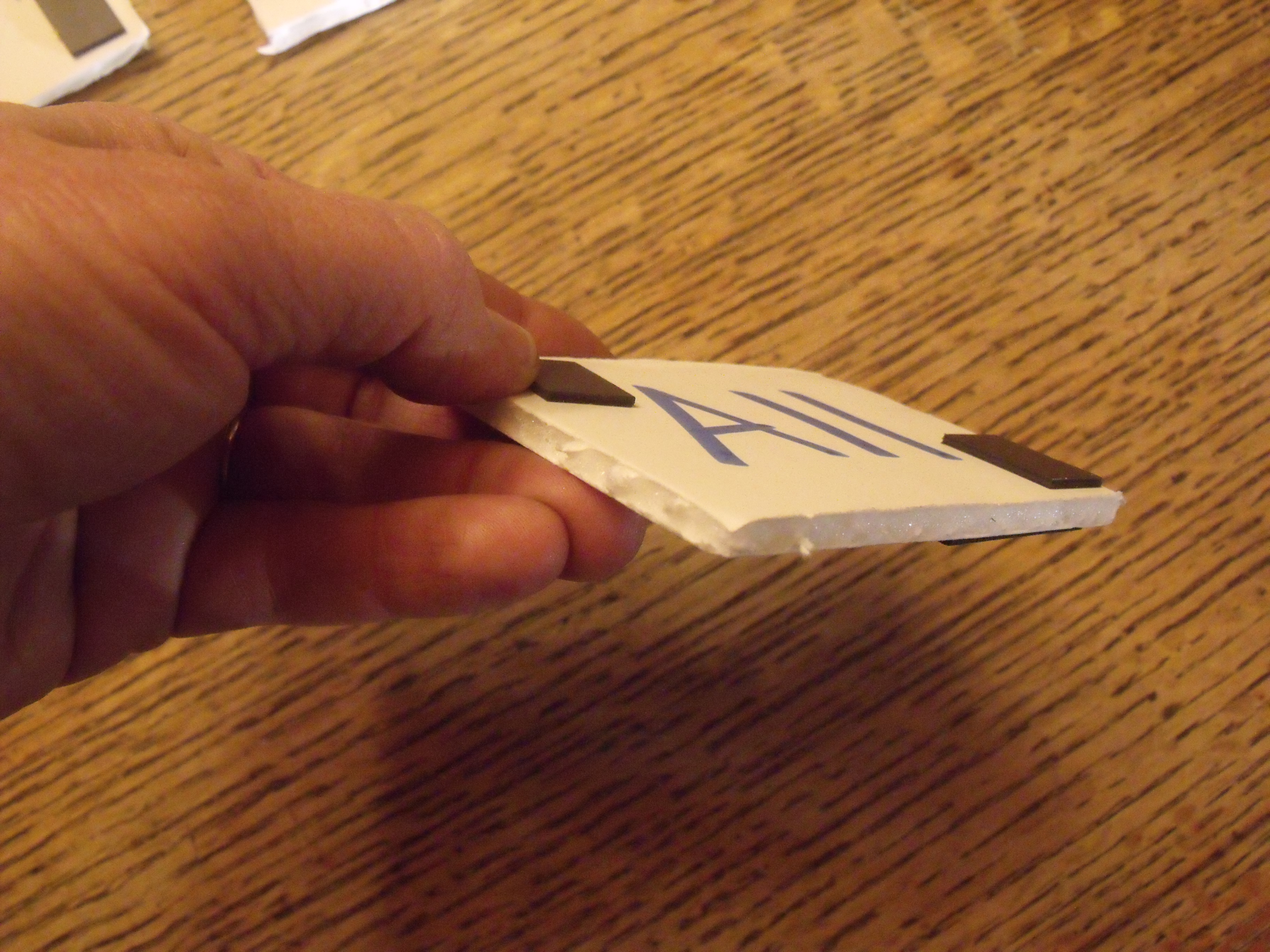
This is foamcore.

I found large sheets of foamcore at Wal-mart for under $5,  I sliced some  2″ strips, out of which I cut rectangles of varying sizes. All/No doesn’t need a big rectangle, but P/non-P does.

I also found magnet strips in the craft section.  They are backed with tape, and can be cut to make the teacher pieces.

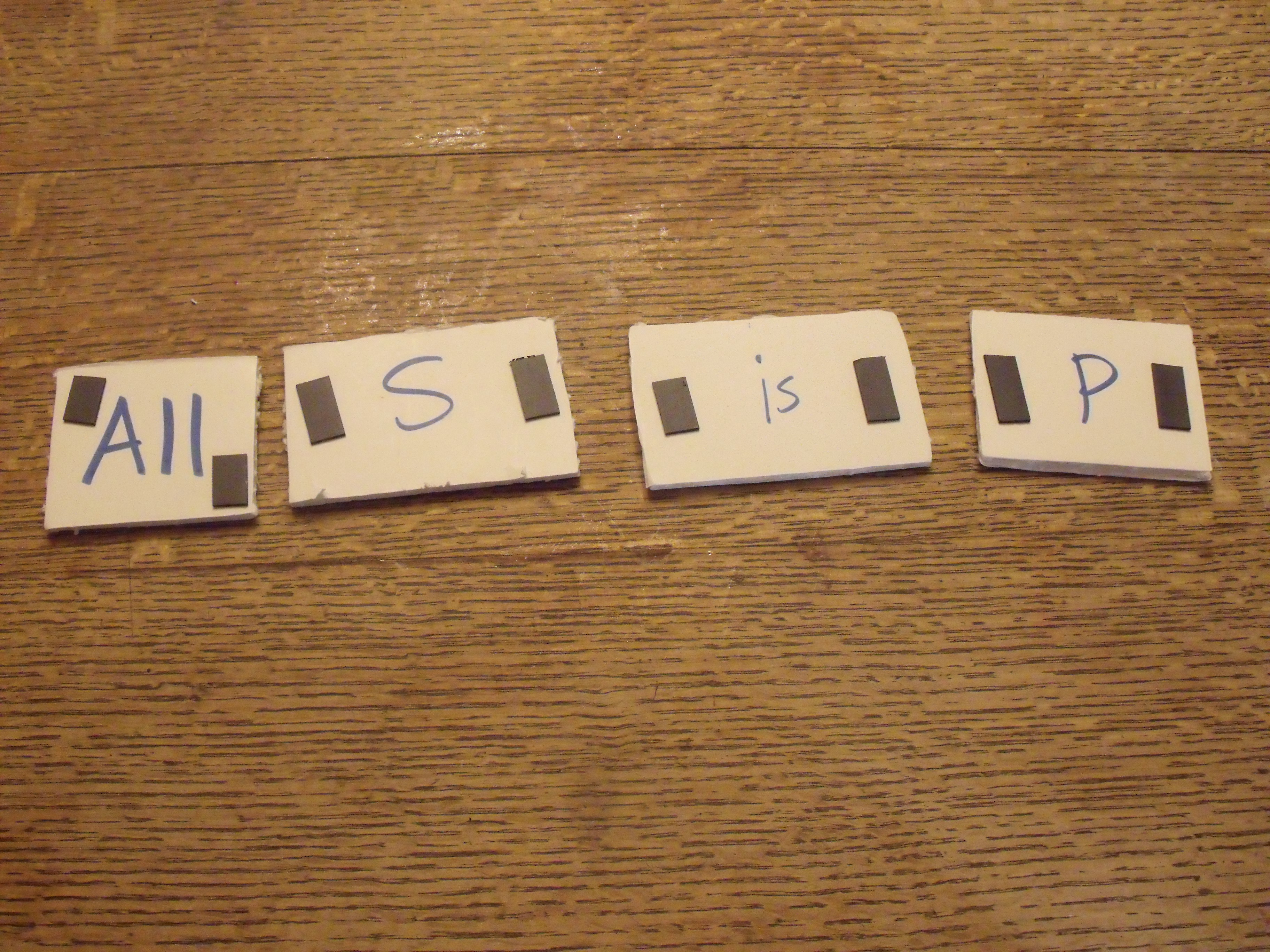
All S is P.

Okay.  I’ll show you how I do the Contrapositive.

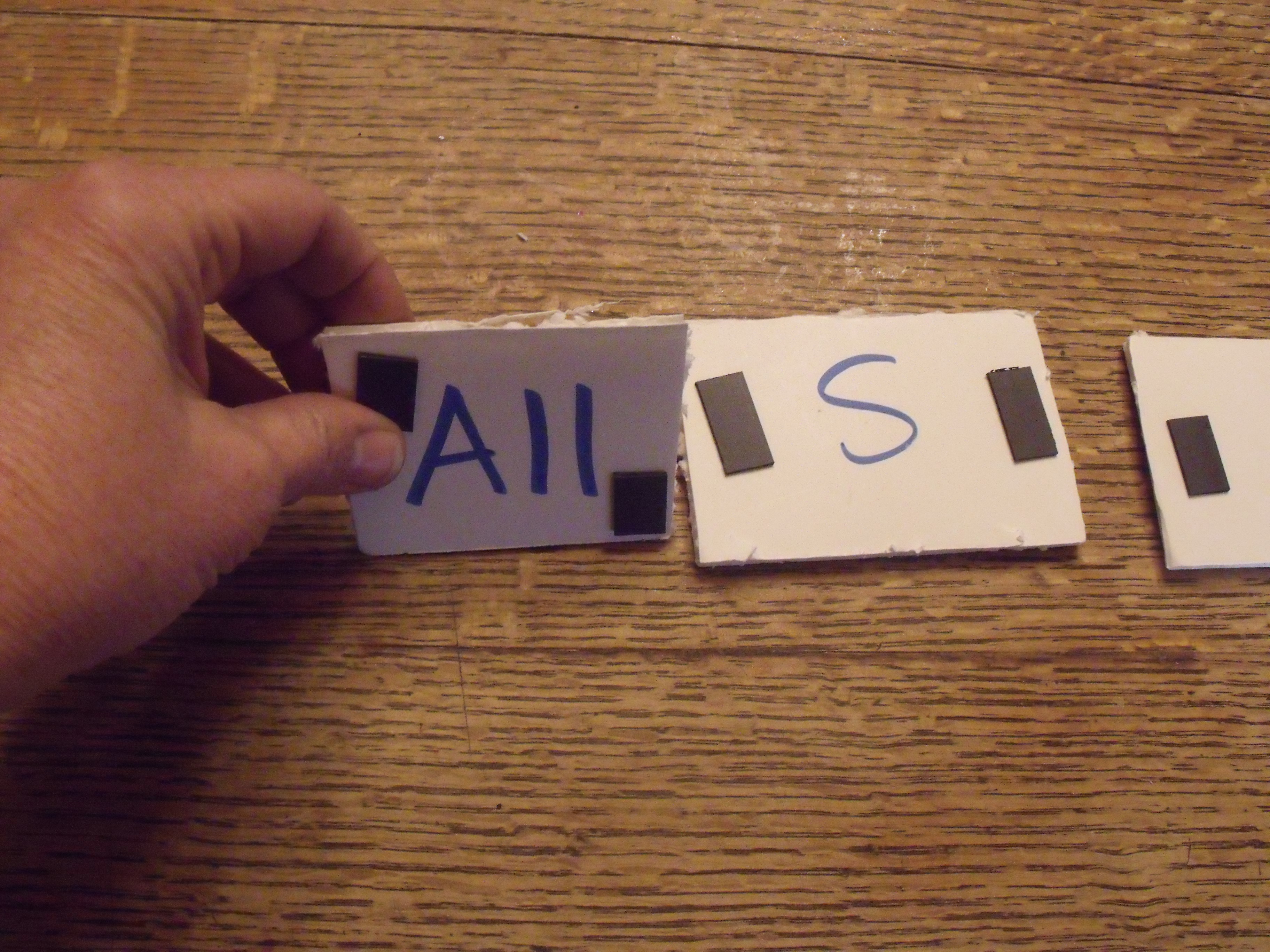
Do the Obverse: “pull down” the All to No…

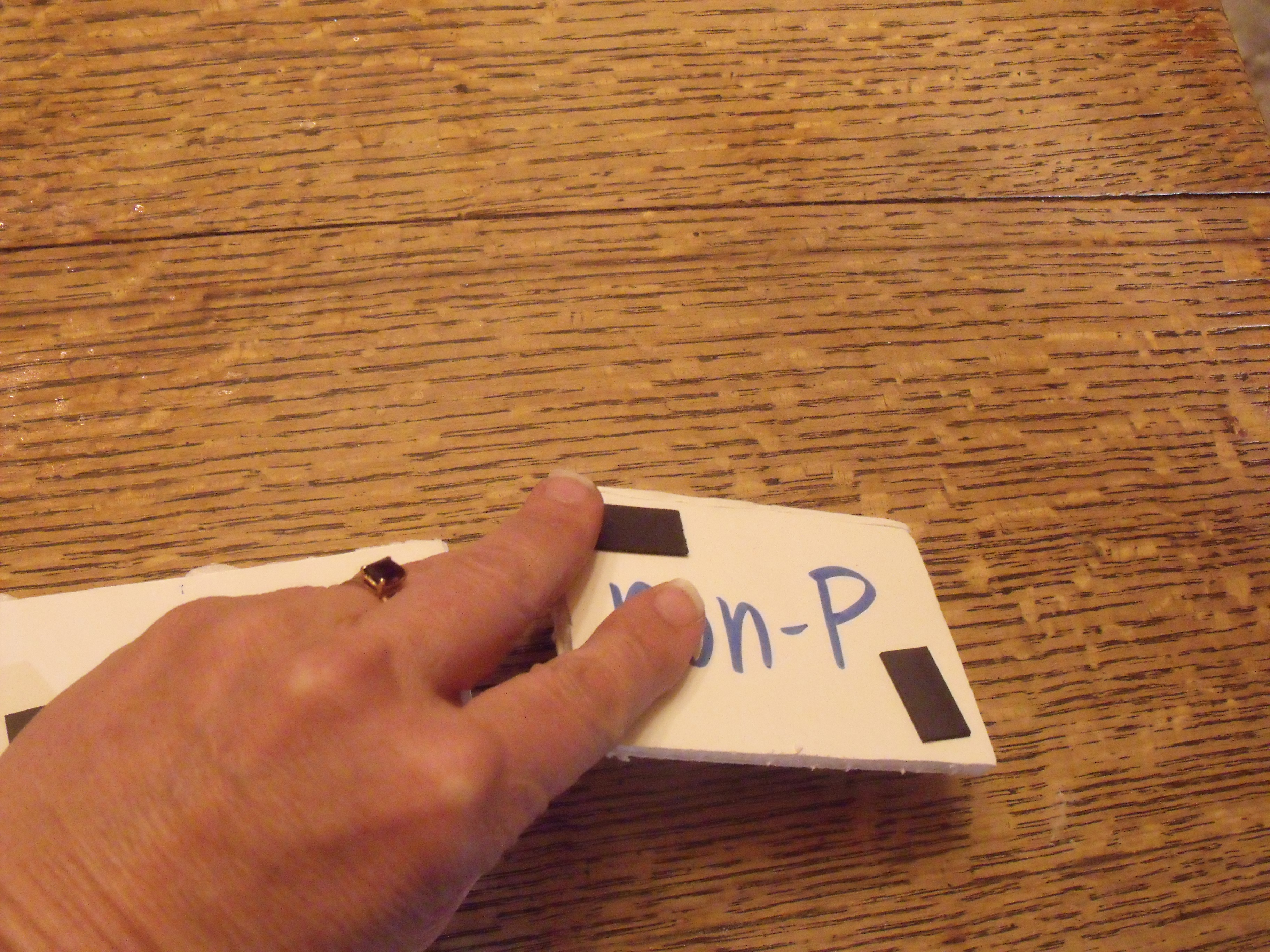
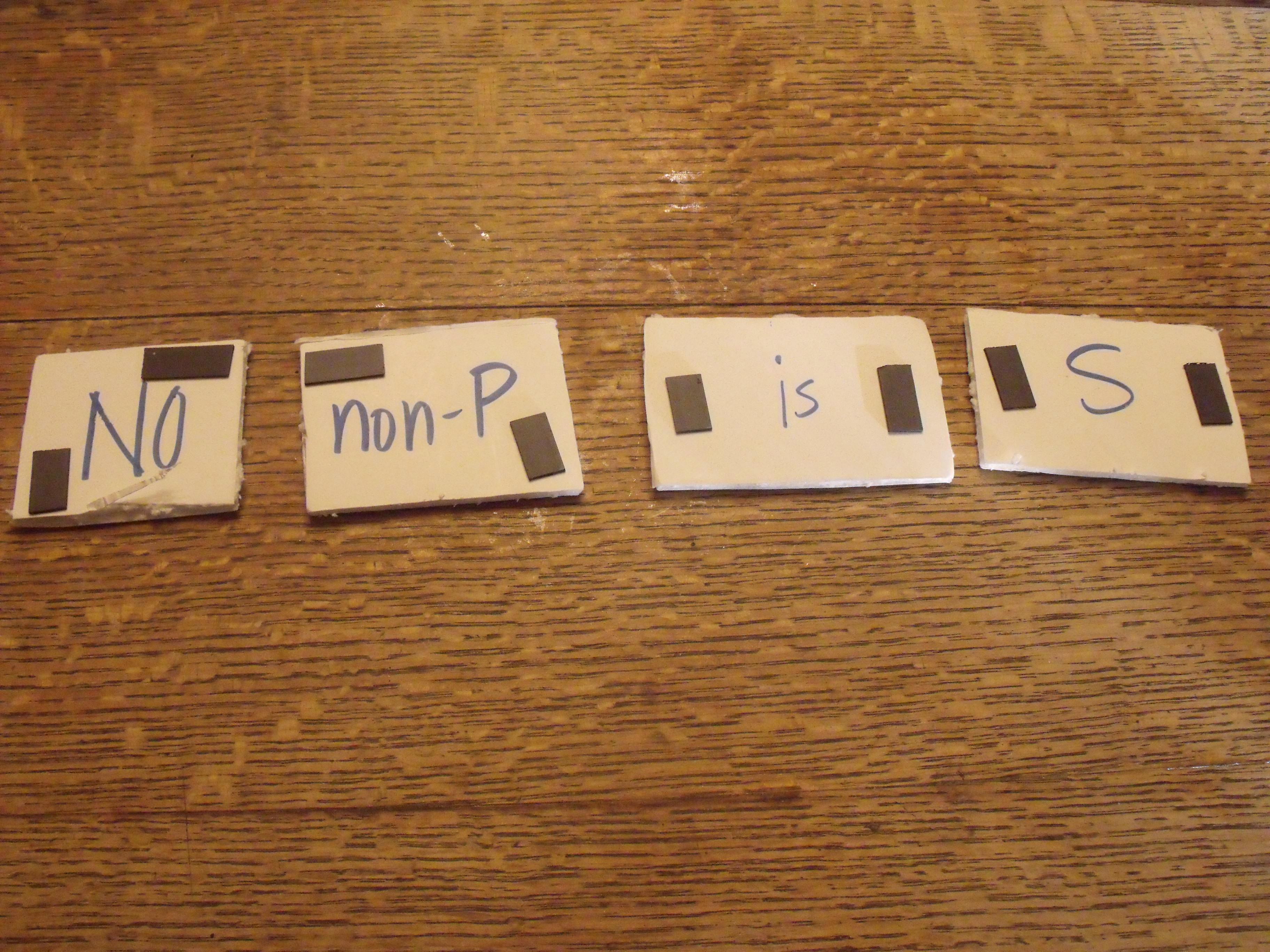
…and the P to non-P.

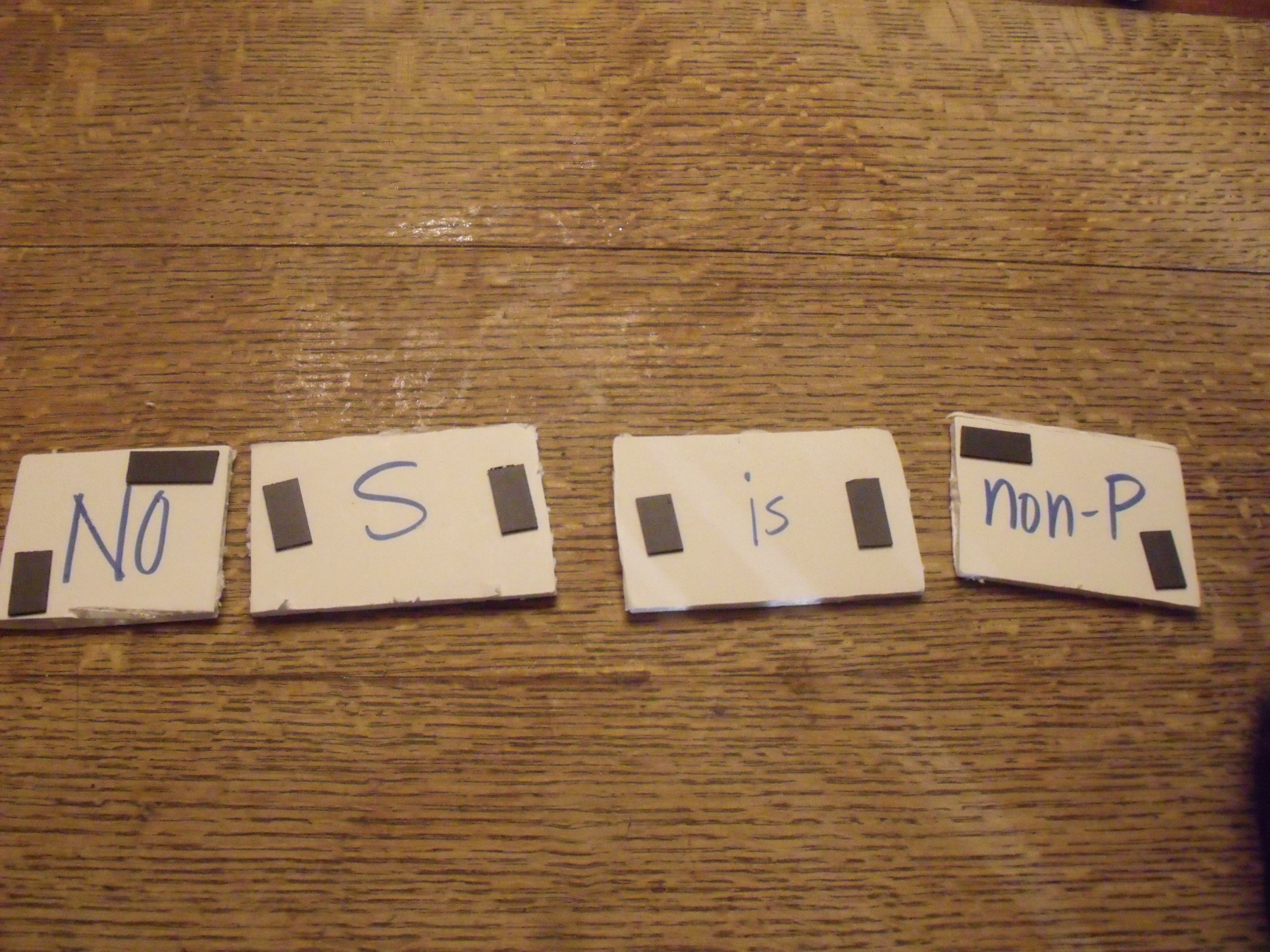
This results.

Slapping these cards on the metallic whiteboard is very satisfying.

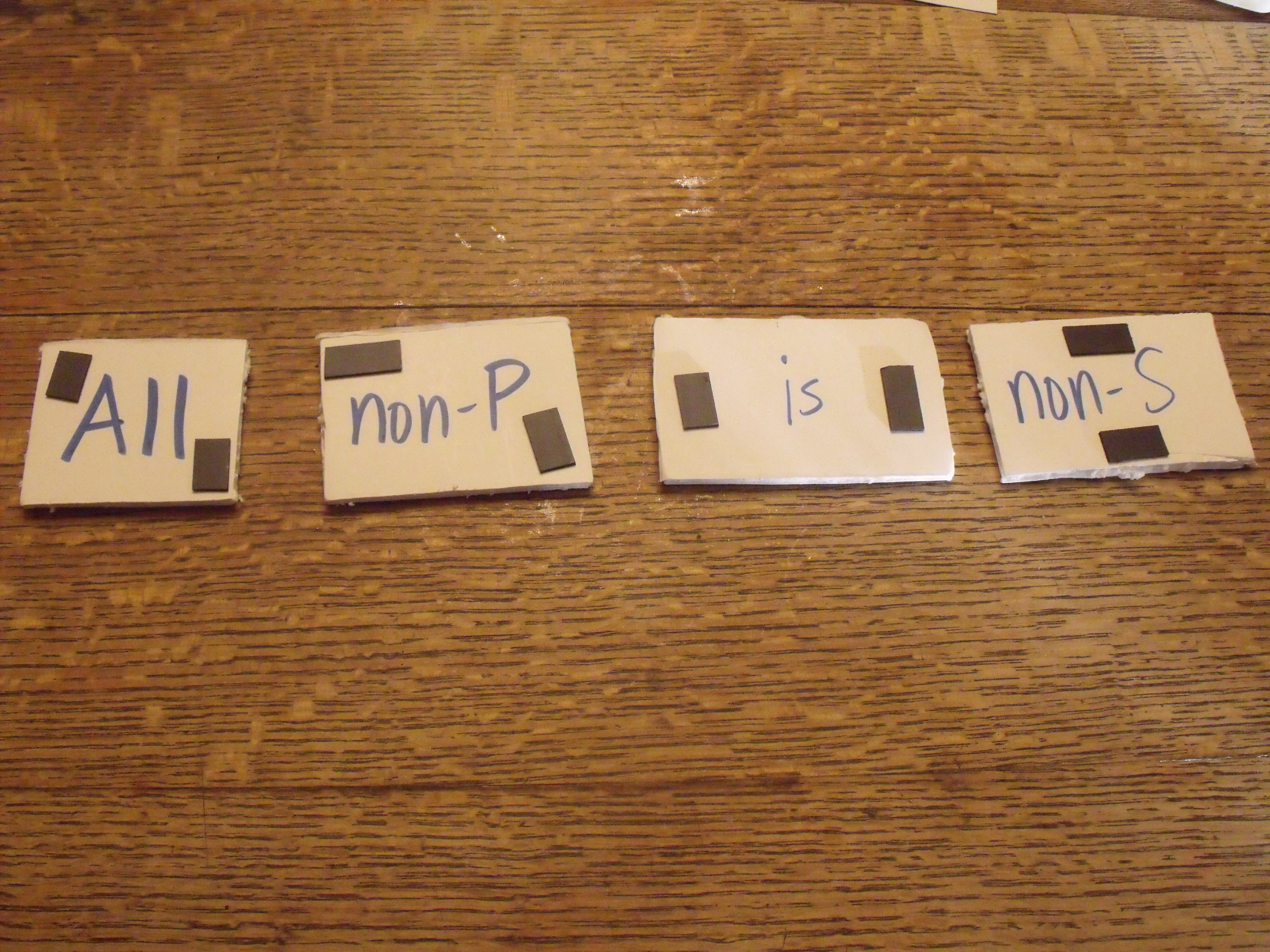
Now we switch S and non-P by Converse, and get this.

By Obverse again we get the final result.

Posted in Classical Conversations | Tagged , , | 7 Comments

Oak-ay, Life is a Beech

You know how foliage glows luminously when the rising or setting sun shines behind it? I was struck with wonder at the Williams River valley as I came over the interstate bridge this late afternoon.  The flamboyant red maples are sticks now, the stately sugar maples have lost almost everything, but the oaks and beeches are in their peak, magnificent in copper and bronze. I always think of Lothlorien when the foliage takes on the appearance of precious metals.

This has become my favorite part of foliage season, and tonight I realized how much it resembles middle age.  I once had the appeal of youth, the glow and glory of good skin and lively spirits.  Now I live the mellowness beyond first flush, and the steadiness of the day’s end when the wind dies and the slanting sun is no longer harsh. I am too tired to be harsh, too content to be windy, too settled to be dancing in a flowing red skirt.

Like coins without number, the reflected glory that filled the valley speaks of the inestimable value of the faithful servants of God who persevere in their given tasks, knowing there will come a season when all they are falls to the ground in a final accounting.

Posted in Stories of Home | Tagged , , , | 2 Comments

Pondering Science with a Vacuum Cleaner

Exploring The Meaning of it All, Richard Feynman’s three lectures on Science

I believe that a scientist looking at nonscientific problems is just as dumb as the next guy. Richard Feynman

Housecleaning is not my favorite thing, but it became necessary to pull out the feather duster and the vacuum to free the family from the tyranny of dust and clutter. A Zune comes in handy, I find, and it was Richard Feynman’s The Meaning of it All that occupied my mind while my hands did the work. These are three lectures he gave at Caltech in 1963, preserved in transcript, and read aloud for me by a dull but crisply enunciating voice. (I would rather have had a little enthusiasm, but the ideas came across just as well, I suppose.)

While I have read intriguing quotations of his before, this was the first extended exposure to Richard Feynman, charming apologist for Science. His childlike delight as he explains what science is awakened memories of nurturing three ivy plants for my science experiment in high school Biology. Science really is about asking questions and wondering ‘what if”. Anyone who listened to him had to come away with a healthy respect for the scientific method, and its benefits to humankind.

However, it was the second lecture, “The Uncertainty of Values”, to which I had the strongest responses. Here is a charming man —intelligent, funny, compassionate– I would love to have at my dinner table some evening, who makes a bit of a fool of himself, speaking to something he does not understand. With affection I would challenge him on his assessment of religion as it relates to science, seeking to open his mind to a few things. In this post, I will address two things I heard: his implication that scientific inquiry does not happen where religion thrives, and his definition of religion as a dogma, a code, and inspiration.

First, an honest inspection of the history of science will reveal a strong connection between those who rigorously sought knowledge (the logos) and a faith that it can be found because God (Logos) created. They were certain to find God’s logic, the patterns in the natural world, because they knew the world had a designer. Men and women of faith who were well-educated in theology, philosophy, mathematics and science had a robust certainty that investigation would not challenge their faith, but would only confirm it.

Second, he isn’t working with an adequate definition. He asks ‘Is there a conflict between Science and Religion?” and defines religion as having three facets.

One, he sees any religious system as dogma, definitively answering questions about metaphysics: the meaning of life, the origin of the natural world, the existence of a supreme being. Feynman says a scientist has no interest in this because, as one who forever doubts and questions, absolute answers are unacceptable. He concludes a scientist has no need for this facet of religion.

Two, it is a code of ethics. The necessity of this Feynman dismisses by pointing to the ethics of men who did not need to be told what is virtue but who come to the same conclusions without it. He makes the mistake common even to those who claim faith in a living God, for man’s nature is drawn to a moral code like a toddler whose eyes are drawn to his mother even as he reaches for the hot stove. We have two tendencies: to create a moral map, and to act outside it. Even those free spirits who excuse themselves from a traditional set of rules still have one, and find it suddenly expands when an offense is made against them. Just as Logic is the road-map of the process of reasoning, a code of conduct is the road-map of an objective good. But while it may be true for other religious systems, for Christianity faith is not, in essence, a code of conduct.

Three, religion is a source of inspiration. It strengthens its believers to persevere through crippling circumstances, and this he sees as its only substantial benefit, even while he marvels that anyone can believe what is unbelievable. Essentially, he concludes that believing a lie can give strength (which alas, is not for him). He would agree there is no truth-seeking person who is content to live by a comfortable story, and I add, no one who will die for it.

But real faith is not about a dogma, a code or an inspiration. The outrageous claim of the Judeo-Christian faith is that God came to dwell in our space-time, both demanded justice for our rebellion and paid the penalty for it, and lives in dynamic relationship with the humans He created.

So there I was, my hands full of the vacuum hose, unable to stop and mark passages that caught my attention. “Wait, Dr. Feynman! You are dancing around the real issue! Wait! You can’t define it that way!” He certainly got me thinking outside my dusty box, and I have more I want to chew on in another post. I want to explore what happens when a scientist like Feynman puts limits on the kind of answers he can seek. I want to understand materialism, and if that is the only option for a person is search of the truth. And can Truth be found? Feynman is certain it cannot, but is that true?
Posted in Science | 1 Comment