High Holy Day for the Hollerans

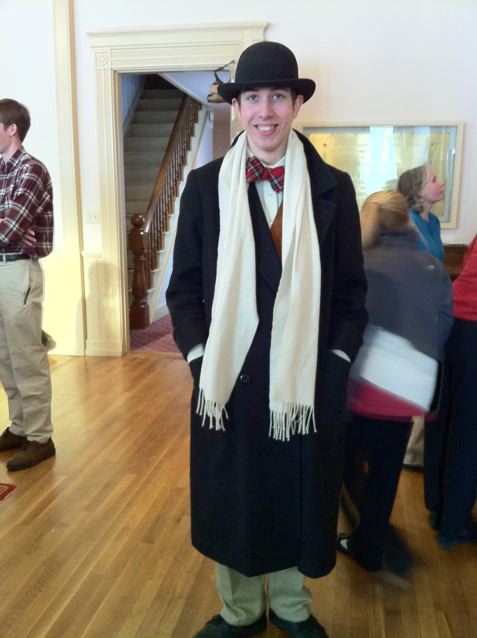
By delaying our St. Patrick’s Day celebration one day we were able to assemble a perfect party. Our tradition is to have three or four new guests at our table, in addition to Robbo’s two bachelor brothers and Grandpa.  This year, Ben’s first in college, Ben got a ride with a freshman at VTC who has a car, and two other ladies were able to join us.

St. Patty’s Day is more elaborate than Christmas for us.  Corned beef and cabbage! Irish soda bread! Leprechaun ale! (Ah, I can’t tell you about that one. It’s magic for at least one new  visitor each year.)  As we approach satiation we take turns reading about Patrick, and Robbo explains how the Irish saved civilization. Then we pass the tall green blarney hat so each can tell a story in turn, earning a gold coin from the leprechaun’s treasure.  Dessert costs a coin. This dessert topped all others I have ever served: chocolate slab and amaretto custard.

The high point?  Sylvia’s sweet, clear voice as she sang a ballad. Nobody expected that from this shy girl.

I managed to get by without telling a story. I cleaned the dishes and prepared the dessert.  Can’t spin a story when I am in task mode. Couldn’t think of a thing to tell.

While the teens and near teens played a violent and strategic game outside in the dark Robbo and I visited with Katharine, our English friend. She is 24 years old, and has really hits it off with Molly.  A precious young woman whose faith is warm and honest.

Good food, good company, and a clean house.  What a satisfying evening.

Posted in Stories of Home | Leave a comment

Japan

I have no words.  Just saw my first videos of the tsunami.

I have heard from one Labo daughter, Kanae, who lives in the south. She has not been physically affected, but she grieves. The other is from Kawasaki, near Tokyo. No contact yet.

Poor, precious Japan.

Posted in Stories of Home | Tagged | Leave a comment

SAT Essay Workshop in Upper Valley

Free one-day workshops offered:

  • March 31 and April 30, 2011
  • 8:15 a.m. to 3:00 p.m., starting promptly at 8:30,
  • Hartland Library in Hartland, Vermont
  • Bring notebook, pencil, and a bag lunch.

“Writing is easy: All you do is sit staring at a blank sheet of paper until drops of blood form on your forehead.” ~Gene Fowler

That rare duck, a writer, appears to have a natural grace in writing but what about the rest of us? If I am being assessed for college admissions on the basis of an essay I write in 25 minutes, what can I do to keep from sounding like a blundering idiot?

Come to a free one-day workshop on essay writing with an emphasis on the SAT essay. Read sample essays, learn how they are graded, and discover what you can do to earn a respectable score. Through interactive sessions, students and their parents will take a close look at the challenges of writing well and work with some helpful techniques. Participants will write two SAT-style essays, before and after instruction, to compare. Anyone who wants to write a well-structured persuasive argument will acquire some tools to use in the craft of essay writing.

Seating is limited. Please register with Mrs. Holleran at ruthellen@vermontel.net 802-875-3021 or the Hartland Library at hartlanddir@vermontel.net, 802-436-2473.

Ruth Holleran has been schooling her children at home for 17 years and is presently a middle-school tutor with Classical Conversations, a home-centered classical program that meets one day a week in White River Junction. Formerly a music teacher, she teaches with a love for learning that won’t quit and a hankering for her students to know the freedom of a well-trained mind.


Posted in Stories of Home | Leave a comment

25 minutes

So. You get 25 minutes to write an essay for the SATs, and your college of choice uses your score to evaluate your readiness for the rigor of college work.  It is part of the profile they compare with the next applicant’s when deciding which one should get one of those last openings. Mastery of this form you do not have–not by a long shot. Who confronts the SAT essay with aplomb?

Over the past year I have had to study and teach the essay form, and now I appreciate it for two reasons.  First, it requires us to state an opinion and then support it, and second, its given form makes room for the writer to be creative in content without having to be creative about a form.

The basic form of an essay is: state the thesis and enumerate your points, take each point and develop the supports, and wrap it up in a summarizing conclusion.  Once this is mastered, other parts are added: Exordium (an opening that draws the reader in), Division (the author states where opponents will agree and at what point they diverge), Refutation (the author states the strongest points for the other side and explains why they will not do), and Amplification (to whom does this matter, and why?). A middle school group can learn it, and certainly a high school student can master these elements if tackled one at a time.

In order to defend a position, one needs to come down on one side of the fence or the other. Am I the only one who prefers not to stir up trouble by stating and defending an opinion that will cause clash? It is a social skill, after all, to agree where you can and keep quiet where to speak might cause an argument. But we are not always sitting at the kitchen table with our grown family, treading lightly in order to make it through a weekend.  Truth is, debate is healthy, and as we grow in our ability to reason through an issue, working through a disagreement can be tremendously satisfying.

So, the first thing a student needs to learn is to take a stand. An essay begins with a thesis, the conclusion he seeks to persuade the reader to make. “Goldilocks should be charged as a trespasser.” “Company dessert should most properly be chocolate.” “My children should not have internet access until they are 21.” Two or three points would “prove” the issue, and each is fleshed out with a few supports. Combined with the Refutation, where a contrary opinion is refuted, the author makes his case with a plentitude of reasons.

The second thing I appreciate about essays is the established form. Form is a wonderful thing–it is the skeleton that makes it possible for me to dance, the rhyming scheme pleases my ear, the plot that keeps me engaged with a book. When I need to order my thoughts on a subject, say for a blog, a proposal to a committee,  or a letter to the editor, I can work with the essay format.  My other choice is to take elements from advertising, that mysterious alchemy that seeks to turn words into profit through reader manipulation, and whose forms are myriad. The essay, which is after all, just a written form of the time-honored elements of oral rhetoric, does all we need it to do, systematically.  Why alter it? Like the steep angle of a snow-shedding roof in Vermont, some things should never go out of style.

So, both for the way it requires us to state a real opinion and defend it with reason, and for its elegant and timeless form I admire the essay.  The SAT essay does demonstrate one’s ability to give a reason for his conclusion, and it need not be a terror to anyone who understands it.

Posted in Stories of Home, Writing about writing | Leave a comment

Give Me a Break

I felt tiny pricks of guilt now and again. Leaving the kids home with their college-age brother who would be more interested in doing his computer project than supervising chores. Supporting the conversion of a former farming community into a seacoast tourism locale. Hanging that “Privacy; do not disturb” sign on our door.

The condo suite my husband chose online turned out to be a winner. Village by the Sea in Wells Beach sits right up on the salt flats, which are brown and dry during low tide, but sparkling and afloat with sea fowl at high. We had the whole resort largely to ourselves when we arrived mid-week, but on Friday afternoon it began to fill up with families.  (I guess we aren’t the only ones to figure out winter is the time to visit the seacoast!)

Our second floor apartment had a kitchen-diningroom-livingroom configuration, and two bedrooms. Two bathrooms, too! And the best–a fireplace. I don’t know what it is about flickering flame and radiant heat, but it sure beats woodstoves for aesthetics.  (Should I tell you this?  The front desk had to send a maintenance guy over to show us how to turn on this propane fire. We didn’t know all it took was a twist of the thermostat! We told the amused fellow we knew all about firewood but were stumped by this fireplace.)

Would it surprise anyone to know my sweetie and I harbor a secret desire to write?  He has been working on a novel every anniversary trip for about five years now.  Two days of writing, then put it away for a year.  But I guess he is always thinking, because he has worked out the intricate plots.  It takes place in pre-Flood Adamland, and involves the politics of the highly developed precious metals mining and manufacture. I think. I know it follows the girl who will become Shem’s wife.

I, on the other hand, worked on a short story. As a tutor for 13 and 14 year olds working our way through an awesome program, I assign a short story for the spring semester. Last year, when I was busy day and night learning this program, writing my own story was the last thing I wanted to do, but now I think I can manage it.  “All I need,” I told myself, “is a few hours to write the rough draft.” Once I got the basic story line down, I could squeeze in time for revisions.

So, we had a writer’s retreat, with that pesky “Do Not Disturb” sign on the door to keep out the distraction of a vacuum cleaning maid. For hours we sat three feet away at the table, he typing at his laptop and I writing with fountain pen in a notebook.

I faced the window and had a good view of the tidewater swelling the marsh until the snowfield just in front of us was awash.  My favorite sight was of two sets of Canada geese standing on ice floes that cruised right to left with the current. At low tide their magic carpets lay jumbled together, grounded.

It took two days to write my story, and on the third night I read it to my guy. Big mistake. Even though we knew it was the roughest of the rough, it just came off as icky.  “Write what you know,” right?  Well, this sounded like a whine from beginning to end. Ha! It’s all right, though; at least I have a structure. Real writing happens in the rewrites, and already I have ideas to rescue it from utter predictability.

So, we retreated from our regular work in order to create and recreate. No Internet access meant we couldn’t get sucked into that dark hole. No emails, no news, no weather.  Just ourselves, a creative project, and the giddy sensation of having shrugged off our heavy responsibilities. It was sweet. Home now, we are picking up the reins that make our waking hours gallop with the thrill of near catastrophe and plod with the mind-numbing tedium.

At night my dreams will be of moonlit ocean, and of wise old geese sunning themselves on a floating island, going with the floe.

Posted in Stories of Home, Writing about writing | Tagged , , , | Leave a comment

Running away

My dad used to tell us four girls, “The first to get married gets the big wedding. The rest get $200 and a ladder.”

Well, twenty-three years ago my childhood sweetheart and I got married in a snowstorm in Vermont. Twenty-one years ago we had our first child, and didn’t stop having babies until the new millennium.  We built our house. We made home our school. We’ve been kinda busy.

In the past few years my sweetie and I have been getting away for our anniversary. It is that time again, and I am leaving it all behind in order to take it all up again, fresh and rested. Where does one go for the bargains this time of year? Not Vermont, for sure. We go to the Maine seacoast. Mmmmm, the Atlantic in February.

But when we come back it will be four days closer to spring.

Posted in Stories of Home | Tagged , | Leave a comment

Evil Emily, GPS

“Always trust your instruments,” my husband says.  And that’s how we got into trouble, for not only was Emily linked to a satellite, but she spoke that cultivated Queen’s English that commanded our respect. We did not suspect our danger.

My daughter and I were driving out to Ohio, a trip of 12 hours according to Google Maps. I had determined to stay out of the lake effect snows in western New York, so our plan was to head onto Route 88 out of Albany, and into Pennsylvania, which is not the shortest route. We were in a rental Ford Focus, and I programed the GPS in it, selecting British English, “Emily”.

I knew by my study of Google Maps that the quickest way was to take Route 90 across NY (which would lead me into Lake Erie snow), and that her counsel would differ from my planned route for a while.  I didn’t study Google printout, alas, for when she gave the unexpected command to take Route 7 as we entered Albany, I didn’t know the wisdom of it. At highway speed already, and with no time to evaluate, that’s what we did, and there began our first sense that we had been commandeered by a hostile force.

My daughter, a new driver, was not up to the task of working out the details, and couldn’t answer whether this shortcut would put us on Route 90 after the exit for Route 88. It did. On I-90 at last, rather than go back, we continued to an exit that had a 2-lane road that could take us all the way down to Route 88. Once we got off, we experienced Emily’s temper.

“Continue .3 mile and turn left, and return to Route 90.”

“Recalculating.”

“Continue .5 mile and make u-turn.”

“Recalculating.

“Continue 1.2 mile and turn left.”

“Recalculating.”

Imagine a cold menace in her voice as she pounded us again and again and we continued to defy her.  It spooked us to know our progress was being monitored by satellite, and its ambassador was not pleased.

Finally, after about an hour, we had progressed enough that the shortest route was the one that lay ahead. Peace reigned, as long as we stayed on the highway. Each time we exited for a pit stop, she barked corrections. Tyrant.  Twice she told us to get off just before a major route change, in order, we think, to put us on a ‘shortcut’. We rejected her advice and got back on. This was not a happy collaboration.

I will give her grudging praise, for she did navigate us through some quick route changes in Akron. On the other hand, she also warned me to get left a few times, making me shift lanes in busy traffic, when all that was necessary was for me to stay put when a bypass forked to the right.

She got us to our hotel all right.  We were on the road 14 hours.

The next day we drove that last 2 hours to the college, had a wonderful day at this wonderful school, and returned to our hotel. The next morning we were shocked to find a dense snow on the ground and in the air, and our first hour was just a black ribbon through a snow-covered interstate in the dark before dawn. We were plagued by increasing traffic that insisted on passing on the slimy left lane. (More than once I saw a car come up the entrance ramp, move to the left and then freeze there in a moment of deep regret.)

Okay, now comes Emily’s revenge. That band of snow was behind us, blue skies above, and we were glad to be on the highway along Lake Erie, Route 90 at last. No snow in the forecast. A short day of driving–only 7 hours from Ohio to my folk’s house.  Emily was silent, for our way and hers coincided.

All of a sudden she told us to exit. We were in Pennsylvania, one exit shy of the New York border. Puzzled, we exited, paid our toll, and emerged in a backwater area of some former industrial city. Emily was dead. She did not respond to her switch, to replugging, to fierce and frantic shaking.  Again we were on a limited-access highway at 55 mph, completely in the dark about her intentions.

We figure she had a stroke, saw it coming, and took us down with her. Her final act was to add half an hour to our trip.

Next time we’ll choose American English. A nice, companionable Texan, right?

“Y’all take the right turn comin’ up.”

“Okay. Gimme a minute…How ’bout this’un?”

Hmmmm. Rand McNally for me, I think. An instrument I can trust, and it speaks my language.
Posted in Stories of Home | Tagged , , , | Leave a comment

Organic

“I want to be a part of something bigger than myself.” I hear this more and more lately, an expression of our natural desire to know meaning and purpose in our lives.  Granted, some people seem to be satisfied to know where their next burger is coming from, but most of us feel this restlessness.  What is out there? Is there something worth living for?  Am I all alone?  How do I make the important decisions when I don’t know where I am going? Who am I?

Today I gathered with a group of people, a diverse mix of ages, education, nations, color, occupations.  But they fell in two camps: male and female.  In each, there were those with high voices, and low–four parts. We sang together, each taking one part. And I thought how marvelous it was to be a part of this living organism, this vox humana, a organ made of voices.  My husband next to me sang the bass parts, providing a solid structure of chord roots and walking smoothly between them. Women sang the high part, the melody, which played off the foundation of the basses.  Altos, the low-voiced women, filled out the chord in important notes, and the tenors, that rare breed of musical high-voiced men, contributed to the chords while supplying the excitement that is inherent in a male voice singing in his upper range.

Together we sang one text, in one rhythm, with one heart. We were singing off the same page, you might say.  There was a place for everyone, even Freddie, the Down’s man who plays harmonica because he can’t read or sing and never will.  There are men who are bewildered by part-singing, but know the tune, and so that is what they sing.   There is no screening for this choir but we all look forward to it with joy. Where do people sing like this anymore?

Some say hymn-singing (for that’s what this is) is too hard, out of fashion, or even elitist.  Better, some suggest, for all to sing melody, which symbolizes that unity we desire in our fragmented and hostile society.  Put a band in front and everyone can sing with them. My heart always droops in sadness when I stand in a crowd and redundantly sing over the leader.  I can’t hear my neighbor, and I can’t even hear my own voice sometimes; I am part of an audience in a sing-along competing with amplified instruments. If I have the sense I am part of a whole, it is as a nameless, voiceless component. I neither sense my individualism nor my part in the whole. While the experience represents a unity, there is no sense of our diversity. My contribution is meaningless.

Today, as I breathed my phrases, singing in complement with Judy’s soprano and Robbo’s bass (the elusive tenors don’t sit in near me, alas), I felt the surge of well-being I often experience at these times.  Picture a spark in each of us, fanned into a flame by our breaths, creating a crackling, light-giving fire. Not just a comforting fire on a cold day, though it is that too, but the purifying, cleansing fire of people who acknowledge their sin before a holy God, and open their lips in praise of Him.  We hear the diversity of parts but sense our place in the living organism of the church of Christ.

It is in hymn-singing I most connect with the organ that is the church, a living body that needs all its parts.  Thanks, my brother and sisters, for adding your set of pipes.

Posted in Art, Stories of Home | Tagged | Leave a comment

Clowning Around

My son and I drove out last Thursday evening to see a clown. He was a local boy who went off to clown college and stayed with Ringling Brothers circus for several years before coming home to Saxtons River.  He still writes and trains clowns for Ringling, and Circus Smirkus, a Vermont-based show that tours the Northeast each summer.    He didn’t perform for us, but ran a slide show of the work he has done with Circus Smirkus. In the essay he read to us, he described his aimlessness in high school. He was interested in so many things and so broadly gifted, he had no direction for his life. That resounded in my son, who knows that feeling very well.

Troy Wunderle (the clown) told how he went to art college for Graphic Design, but in his senior year realized he had developed only one interest out of many, and that he would not find the challenge and satisfaction in design alone. He decided to apply to clown college.   Just as he was about to graduate with his Graphic Design degree, the school sent him a client, who needed work done immediately. When Troy called to explain why he needed an extra two weeks, he discovered the fellow at the other end of the line had also been to the Ringling clown college.  He became Troy’s mentor.

Clown college led to a contract with Ringling Brothers, and later to work with Circus Smirkus.  Later, he developed his own company, “Big Top Adventures”, which takes his special brand of entertainment to public, private, and public school events.

One of qualities that makes him unique is his heart.  He writes a tender moment into each of his shows; he reaches out to the hard-to-reach wherever he goes.  He is not just about entertainment. I could easily see a thoughtful, creative Christian choosing to be a clown, and to serve the Lord winsomely in this way, to His glory.  After all, clowning is about communicating a story through a person.  I see connections.

My bowler-hat wearing son dabbles with contact juggling and gymnastic feats, and has a flair for comedy, and could certainly develop skills that might gain him entry into the world of the circus. But even if he doesn’t go in that direction, we were both encouraged to see how God, in time, can place him exactly where he needs to be, for His purposes.  That’s a comfort.

Dressed but no place to go

Posted in Stories of Home | Tagged , | 3 Comments

Comrades

I have been scrambling this week in response to some unwelcome news.  Of the two students I have in my all-day seminar, only one is returning. The second, a bright girl I was getting to know, will be big sister to two new siblings when her parents adopt from Ethiopia this winter.  The family feels the disruption will be too much for their homeschool efforts, so they withdrew from the program.

That leaves me with one 13yo boy, and a curriculum that directs classmates to debate, share papers, and compete in learning games throughout the day.  Now I am looking at a day of tutoring one-on-one. Not much fun for him.

Well, after I got over the shock, I realized I have a splendid opportunity to expand our studies. He likes to play logic games as I do, so we’ll start a running backgammon or cribbage game to pull out when we finish the material 20 minutes early.  During our Origins hour, I can supplement with excerpts of some excellent movies. He likes to write, so the Short Story hour can finish with a writing exercise that makes practical something I just taught. I can do this.

Defeating Darwinism by Philip E. Johnson made me morose last year. I knew I was teaching it badly. While its ideas intrigued me, it was a plate of room-temperature noodles to my middle-school boys.  Too abstract to be appetizing.  I have read so many books on worldview, natural philosophy, and evolution/design since last spring that the concepts in this book now reside in a web of connections.  We’ll also study some of the questions an evolution-taught person might have for us.

I had an epiphany this weekend as I read the chapter we’ll be discussing.  This book makes me feel like I am at the top of a rickety ferris wheel. The feeling of unease comes from the whispering doubts “How can this adequately prepare us to debate one of those frothing-at-the-mouth proponents of evolution who see it as the only possible answer for how life began?” Johnson seems to give me Rand-McNally road atlas to stop a Sherman tank. I can show the driver how he is on the wrong road, but he’d rather run me over!

The statistics persuade me to hope. Only 9% of Americans really believe evolution completely.  The others have a reasoned position for creation, or think they can mix Darwin and God, a position that cannot stand to scrutiny. Most do not understand the implications of the theory that all life came by random mutations and natural selection. Most hold to time-tested values but can’t understand why these are being undermined one by one. There is certainly a connection.

So, what has set me free? I will leave the true believers alone. I will prepare to engage in conversation with the ordinary person who intuitively understands he sees design all around him, but was only taught evolution to account for it.  As I have learned from the examples of Chesterton and Doug Wilson, C.S. Lewis and Nancy Pearcey, this can be a civil discourse with laughter and camaraderie, not a military campaign.

Here’s to a winter of laughs and comfortable companionship with a future leader, who may one day look back at the semester that began in disappointment, and tell his friends it wasn’t all that bad.

Posted in Classical Conversations, Science | Tagged , , | Leave a comment