National Number Knockout

The fellows of Mandala Fellowship, a pilot year of a quadrivium program attached to Classical Conversations, are on the verge of successfully starting a national math contest. With just over two days to go (as of this morning) they are within $2000 of their goal with Kickstarter. If they can raise it, they will be able to fund the first (annual) national competition that is to math as the Scripps is to spelling and the National Geography Bee is to geography.

They are very close. Will you consider a small donation to make this happen?

To understand, watch one of the short videos or read here: https://www.kickstarter.com/projects/880708408/national-number-knockout

My son is Barnabas, the fellow in a brown jacket who walks toward the camera, catches a notebook, and shows it before tossing it aside.

Posted in Classical Conversations | Tagged , , , | 1 Comment

Challenge B Rules

Let me state this plainly: the Challenge B tutor has the best position in Classical Conversations. We wrestle Logic to the floor, we train opinionated kids to argue, and we watch children grow up into young men and women attorneys who go into battle in a courtroom.

Yeah, I’m a Challenge B tutor.

Five years ago my wise and strong-minded friend, Marcia,  told me it was time I checked out Classical Conversations, even though her campus was 45 minutes north on the interstate.  But an Information Meeting smacked me between the eyes and told me the classical education for which I pined was possible for us!

The fact that a Challenge program did not exist for my older kids did not trouble Marcia. She serenely informed me that I could become a tutor and both help the campus grow and earn something toward my tuition costs for six children.  Magnanimously, she let me study the catalog and choose which level I wanted to offer, Challenge A or Challenge B. (These are roughly equivalent to 7th and 8th grade, but  the skills taught and the content covered are fitting for a high school student new to classical education methods.)

It didn’t take me long to see how my background, temperament, and curiosity were suited for Challenge B. Logic, the centerpiece of the program, really captured my interest, because I could see the value of teaching kids how to reason well at this early stage, knowing what a fantastic foundation this would make for all future studies.

To get my training I traveled to Wilmington, NC and there I attended a practicum, had my first Krispy Kreme doughnut, and tasted a peach milkshake from a store whose misspelled name stumped me. Was that Chickfilla?

That first year I studied something like 15-20 hours a week because I was young and inexperienced and thought I needed to know everything.  It proved what Leigh Bortins said, that we are seriously undereducated. I didn’t know who Michael Faraday was or why I should care.  I had to study my Latin grammar and spend time translating until I was getting the right answers more often than not.  I had to learn how to lead discussion rather than tell students what I had discovered.

But I also became reacquainted with Algebra, which I loved as a teen.  And the same with Logic, which I studied in college in a text not nearly as witty as this one. I learned how to argue coolly and persuasively. Four of my own children have come through my class and have all grown into thoughtful people. But its effect on me has been the most profound. It has trained me in the classical methods, so that now I can tackle any large project with confidence.  It has taught me to read a book, tell a story, talk to strangers. Someday I may even feel the confidence to stand up at Town Meeting and speak so persuasively my neighbors will find themselves voting against their will for such things as fiscal responsibility, small government, or the right for unborn babies to live. Ha!

When a parent of a 13-15 year old visits the campus and dithers about where to begin in the fall, I am all courtesy and deference, when what I really want to do is grab the mother by the shoulders, stare her in the eye and say, “Do not miss this class.  You will never regret putting your child in Challenge B.  Give that child a solid year of Logic (and Algebra and Latin), dialogue (Literature, Science, Current Events, Mock Trial) and writing (Lost Tools of Writing, Science, Mock Trial.) This year, be a B.”

And the parent who considers taking on the task of tutoring B, the precious privilege of working with children who grow wise before your very eyes?  The students and their parents are not the only ones you bless.

The one who benefits the most is you.

Posted in Classical Conversations, classical education, Lost Tools of Writing, Practical Tutor | Tagged , , , , , | 8 Comments

The Sunday Evening Tug

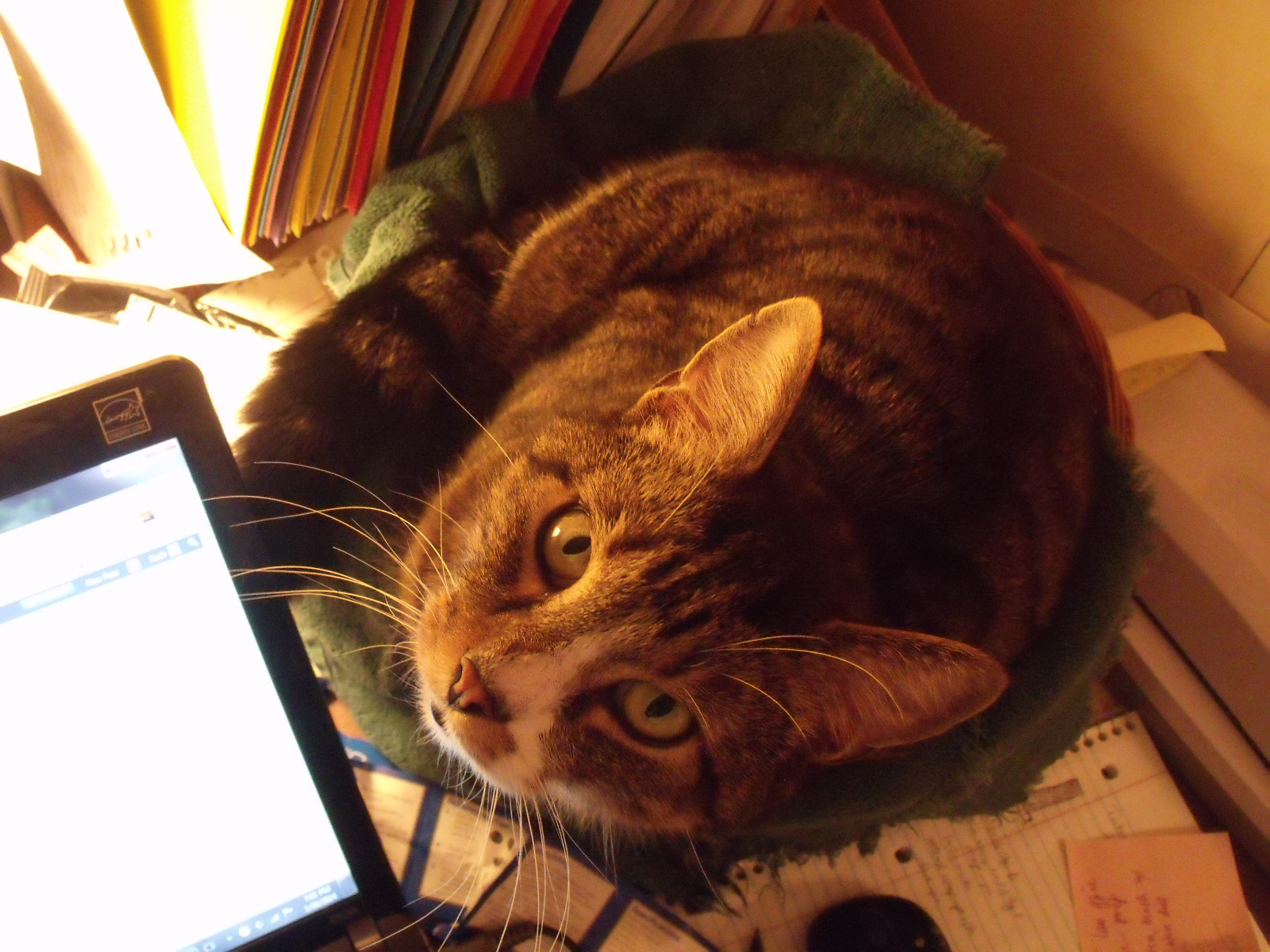
I have confined my aggressive cat to a towel-lined basket near my laptop so I can type without interference. My keyboard is dusted with fine cat hairs.  Sometimes he wades through my desk papers and climbs onto my lap and I can’t find it in my heart to shove him off. I am a pushover for a purring cat.DSCF5910

Sunday evenings used to be my blogging time but a full house and schedule through Christmas break bumped that aside. But then, even before the three kids went back to college I signed up at a local gym and have found Sunday evenings perfect for taking a walk on a treadmill and making my muscles burn with weight machines.

This is a funny turn for this bookworm: weight-lifting. Yet, I have my sights on biking this summer. I don’t want another summer like the last, where I felt so out of shape I stayed in the valley instead of making the hill route my default. That 3.5 mile ascent puts me in shape in a hurry and I want to be ready for it this spring. That’s what I think of when I walk the treadmill, pump weights, or sweat through a spinning class.

The gym has a strange attraction for me. I can usually claim a treadmill, where I walk for 20 minutes (with a 4 minute cool down) alongside strong young women who run. It feels really good to stride in big swinging steps, and the endorphins make me happy. Then I make a circuit of lower body or upper body machines where I aim for two sets of 12-15 repetitions. I carefully write down my progress and have watched my weight increase on almost all the machines. That pleases my record-keeping soul.

I entirely ignore the men and they return me the favor; in fact, the only one who seems open to talk is an older woman who, like me, sometimes shows up before dawn. We have the place to ourselves then.  She and I met again at my first spinning class and huffed and grew red in the face together.  Our instructor is a drill sergeant and I am in bootcamp. I accomplish far more than I thought possible.

Well, as late as it is, I think I will drive down there. I always save something to listen to on my MP3 player. Last week I listened to The Railway Children but tonight I have some Radiolab podcasts to try. I got hooked on the podcast on colors. RadioLab Colors My favorite part is where they let us hear what colors various species see.  Really, you have got to hear this.

Tomorrow is Mad Monday, where my children and I pay for all our wasted opportunities of the week by fitting nearly two days’ worth of work into one. We want to be ready for Classical Conversations community day. It is a workout of a day, but it pays off in endorphins of a different kind.

Posted in Stories of Home | Leave a comment

Mock Trial TImeline

Dear Readers,

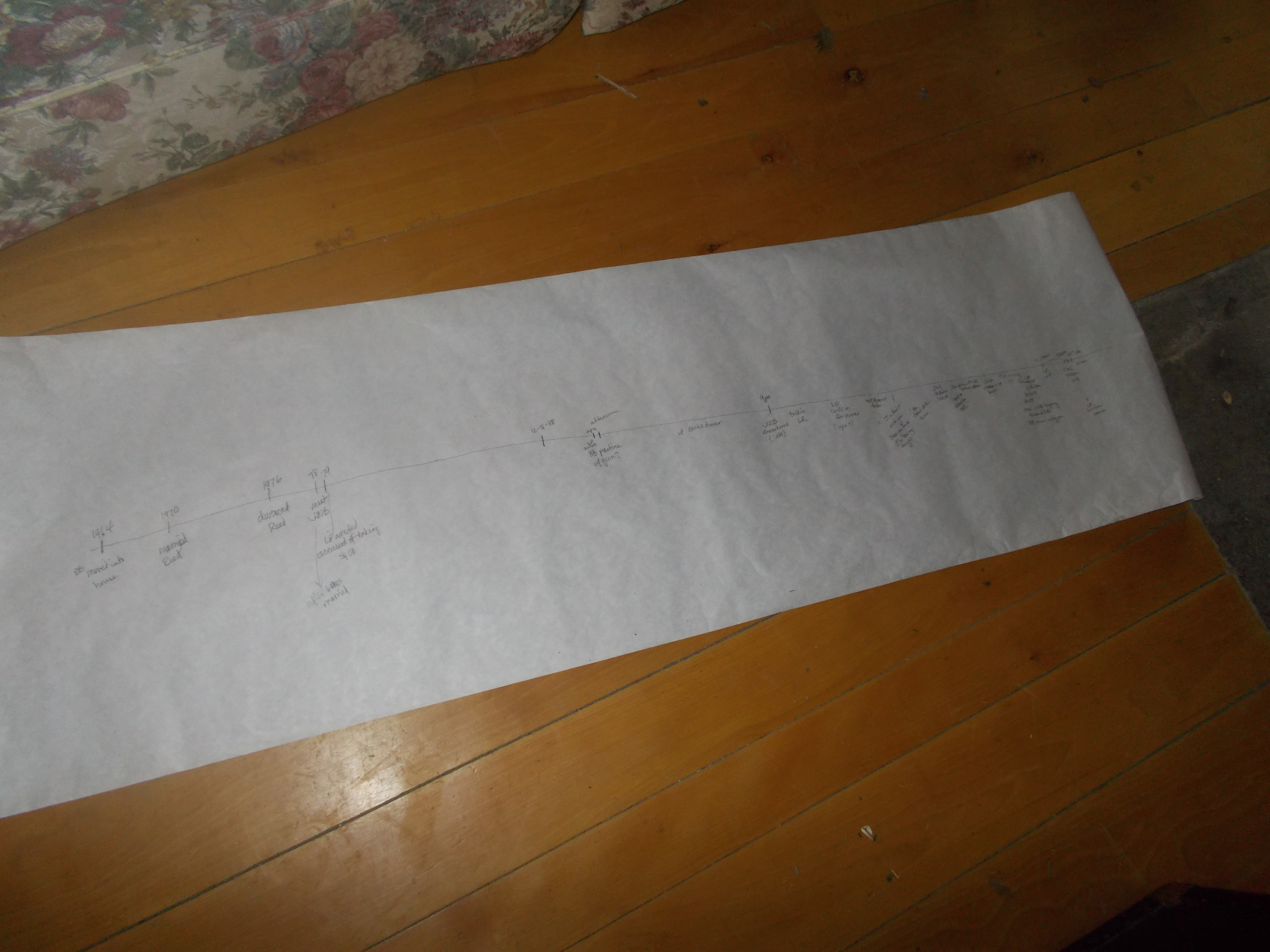
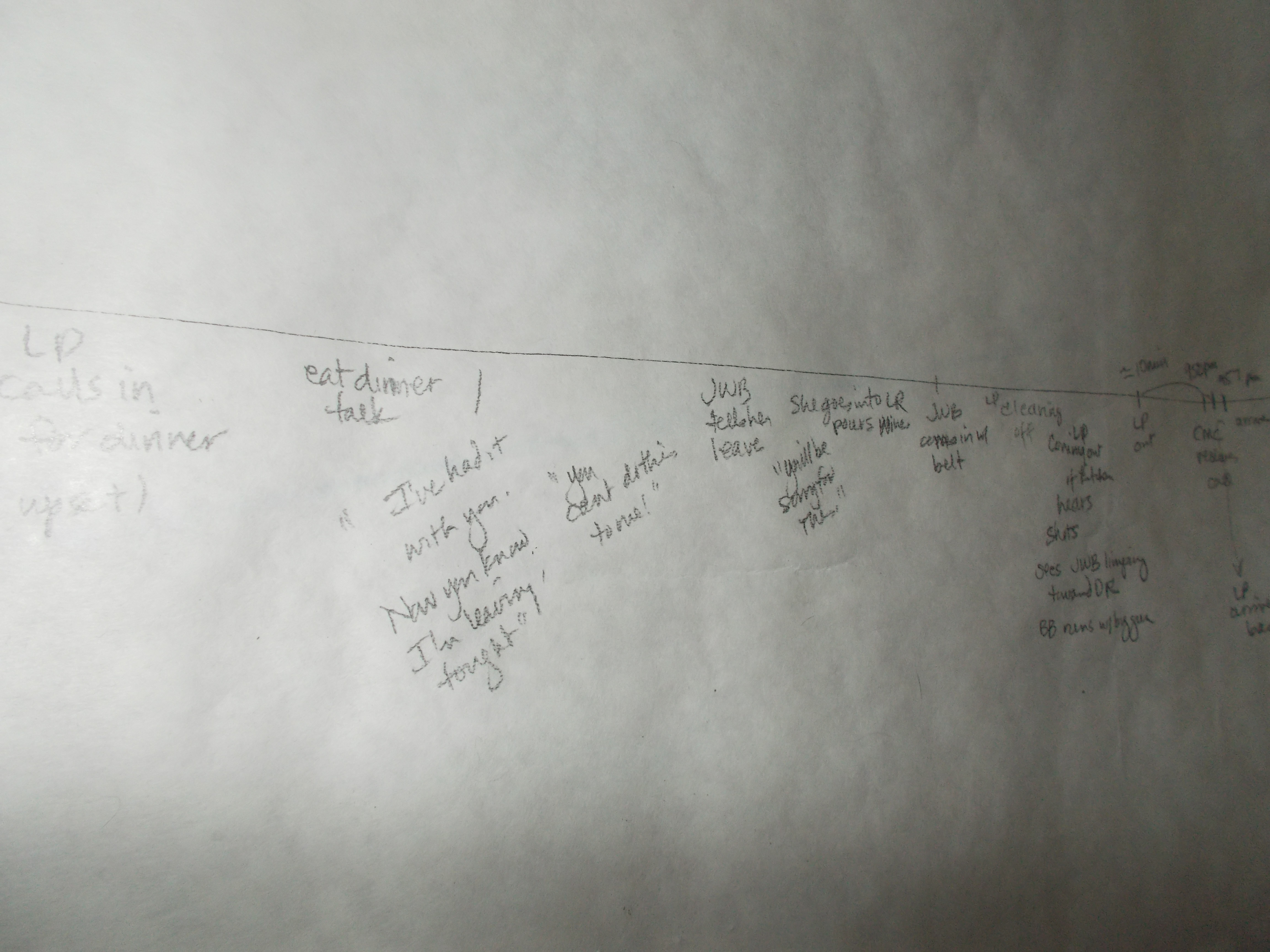
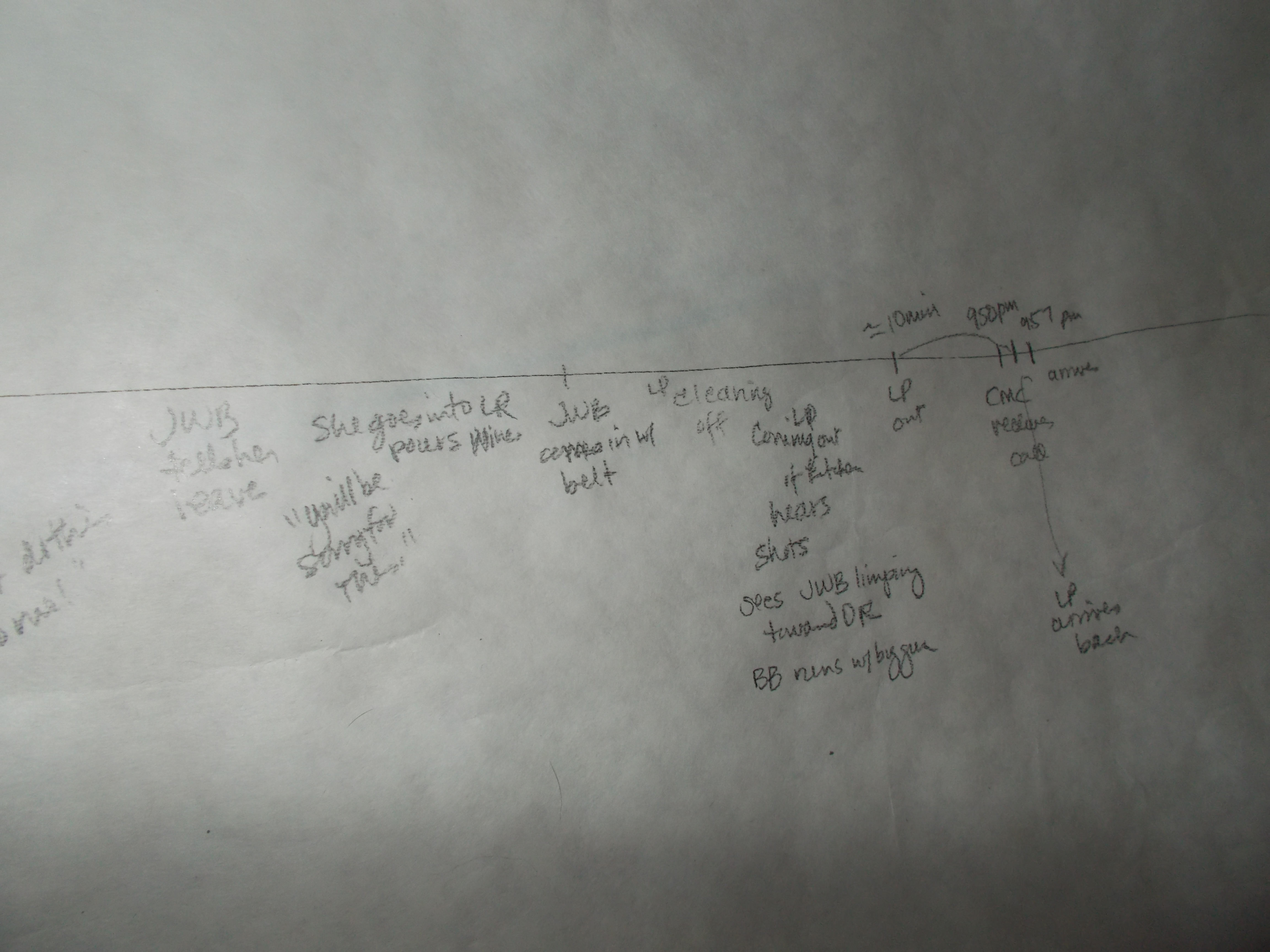
This post is for Challenge B tutors who, like me, are working on the monumental task of preparing our students for Mock Trial in May. During the research phase of the project we are creating a timeline.  Last year I made mine on freezer paper and added to it when we discovered new details.  Here is what it looks like all together:Image

Here are details:

Image

Image

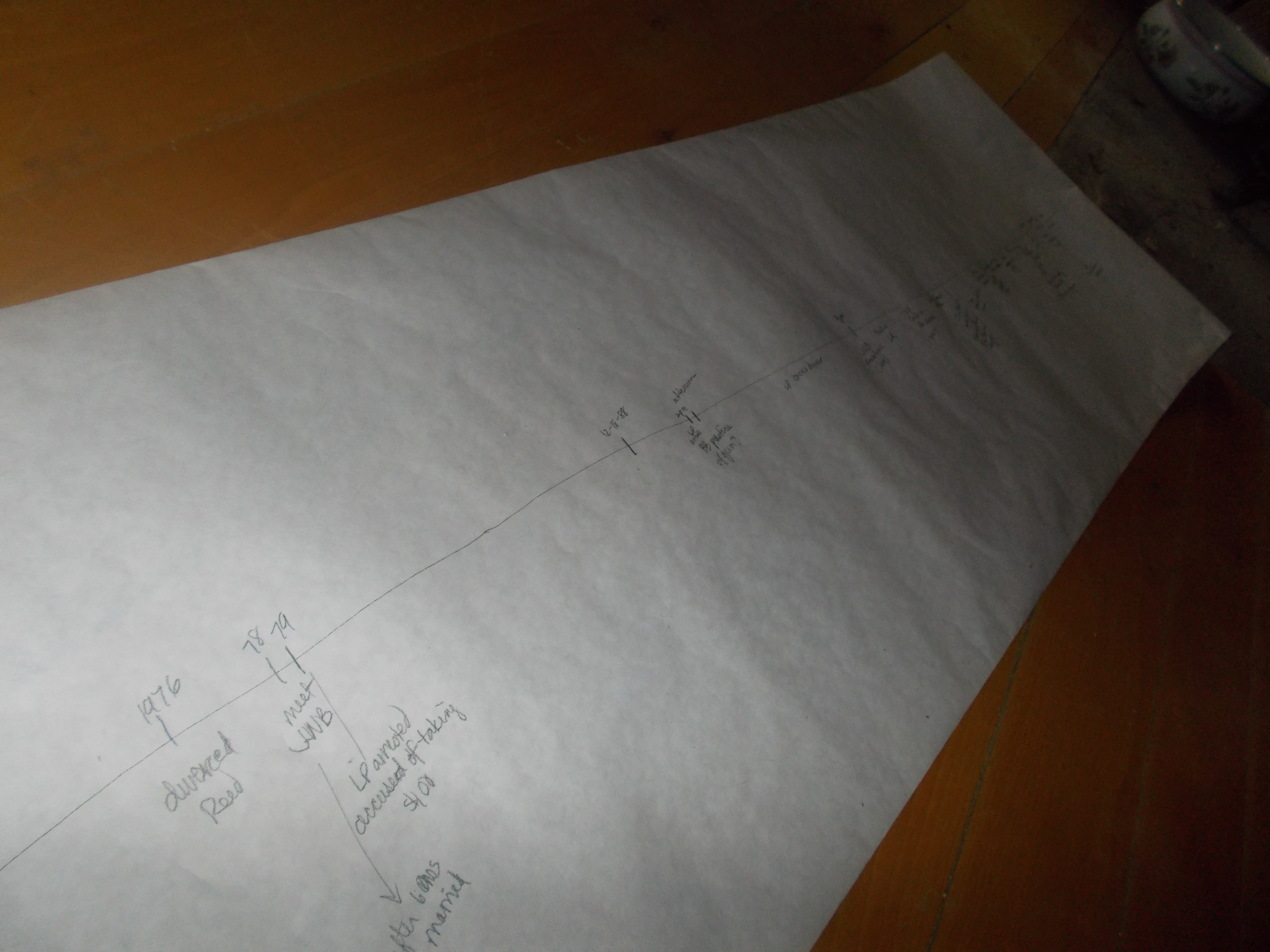
We noted the events that took place long before the case:

Image

It isn’t necessary to do such a big production, though. Regular 8.5 x 11 paper in landscape orientation will do just as well. And some people prefer their timeline as a list on lined paper, going down rather than across.

Hope that helps.

Posted in Stories of Home | Tagged , , | 2 Comments

Andrew Kern Nails the Difference between Conventional and Classical Education

Andrew Kern of Circe Institute, a classical education think tank, explains how classical education contrasts to conventional at the heart.  If one is about the search for truth and the other for power, I know where I want to be found. It reminds me my ultimate goal in working with children classically is not to make leaders, but to train souls to love and seek the truth. What comes of that I will leave to God, because the truth is I can’t make anyone a leader anyway.

http://www.circeinstitute.org/blog/what-difference-between-classical-and-conventional-education

Posted in Classical Conversations, classical education, Stories of Home | Tagged , , , , , , , | Leave a comment

The Art of Conversation at the Thanksgiving Table

Classical Conversations just republished an article of mine on Throwback Thursday, that widely popular gift to harried editors.  They get a reprieve from chasing down temperamental writers one day a week, and good articles get another airing.

A few years back I wrote about some activities that made our Thanksgiving memorable with laughter, poetry, and music. 

http://www.classicalconversations.com/easyblog/making-a-home-for-the-holidays

Posted in Art, Classical Conversations, Culture, Literature, Poetry, Stories of Home | Tagged , , , , , | Leave a comment

Thoughts on “A Snowy Evening”

Rain falls on the tin roof outside my office window. No snow tonight; it isn’t even in the forecast for the week. Nevertheless, I am thinking of snow, as I have been reading Robert Frost’s “Stopping by Woods on a Snowy Evening”.  Since I am also reading Poetic Knowledge: the Recovery of Education (James S. Taylor) I am reading this familiar poem to make connections to ‘poetic knowledge’.

Taylor’s book is challenging for me to understand. If the book is brick and a bracing wind, the poem is comfortable and a warm mug. It is like a pillow into which I lay my head and think private thoughts. I can pull it in close, while I have yet to wrap my mind around the thesis of Taylor’s book. And yet, Frost’s poem teaches me two things about poetic knowledge: that poetic knowledge is what we experience between appointments, and that it can make us know reality in a way no science can.

Since Taylor does not define poetic knowledge in one tidy paragraph, but rather triangulates from many angles, I am going to take a stab at defining it myself. “Poetic knowledge” is the sensory-emotional experience we have with reality. It contrasts with “scientific knowledge”, which consists of the quantifiable, empirical facts of the subject. While both use the senses, poetic knowledge moves us, whereas scientific knowledge informs our intellect.  That means on the subject of snow, I know it poetically by standing out in a snowstorm and feeling it fall on my face, listening to its whisper as it lands, shivering in the chill of snow-perfect weather.  Scientific knowledge covers the chemistry of its crystal formation, the effect of temperature on shape, and the knowledge that the upper atmosphere conditions are ripe for eight inches to fall. (I must say, the latter knowledge moves me. Whether to delight or despair, it depends how far we are into the winter calendar.)

Read the poem here:

First, “Stopping by the Woods” teaches me that poetic knowledge comes when we pause between appointments.  I experience something deeply when I am intentional and in the moment.  It happens when I read aloud to my family and we are moved to laughter or compassion by a well-written story. When we pause to watch the downy woodpecker eat peanut butter suet, or practice dance steps in the kitchen with my boys, that is poetry in action. Frost lives in the moment of the snowy night, rather than thinking of his journey as a waste of time between important moments. I think our promises are better kept when we pause for meditation, and this leads to my next point.

Second, I perceive reality more fully through poetic than through scientific knowledge.  We need both, but facts cannot tell me what something means.  Though poetic knowledge is not primarily about poetry, poetry is its highest expression.  Implicit in excellent poetry is the sense that our lives have transcendence. Poets bring order out of random experience, beauty out of the commonplace, meaning out of the mundane. This poem’s rhyming scheme weaves between verses with its aaba bbcb ccdc dddd arrangement. Stanzas do not stand alone; they are interconnected, like my many tasks and cares. Repetition of the sounds gives a sense of unity, and the contrast lends interest.

Frost makes me feel the tug between my responsibilities and my need to meditate, to process what I observe through the day. Just the act of reading a poem acknowledges transcendence over utility. I am not merely the sum of my tasks. I am a work of art encountering a work of art.

Scientific knowledge and poetic both work in me to interpret reality. If poetic knowledge is a warm-hearted woman, scientific is the competent man who marries her. He knows a good thing when he finds it!  Together they explore the world; she teaches him to delight in his discoveries of the natural world and he grounds her by showing her the patterns. Frost’s scientific knowledge of the craft of poetry led him to use iambic meter in four feet, onomatopoeia suggesting the sound of downy flakes in the easy wind, and the steady pulse of one and two syllable words until the jarring “promises” that intrude on his meditation. When we live with both, we love what we do.  I think of the sparkling countenance of Linnaeus, who loved nature’s creatures as he grouped them in binomial nomenclature for posterity. Wouldn’t you like to know him personally?

In contrast, I do not think Darwin loved his life’s subject.

I will end by quoting Frost again, this time from “Two Tramps in Mud Time”. Though he speaks specifically of uniting his work and his affections, without too much trouble we can think of poetic and scientific knowledge this way:

But yield who will to their separation,
My object in living is to unite
My avocation and my vocation
As my two eyes make one in sight.
Only where love and need are one,
And the work is play for mortal stakes,
Is the deed ever really done
For heaven and the future’s sakes.

Posted in Art, Culture, Literature, Poetry, Science, Stories of Home | Tagged , , , , , , , | Leave a comment

Obamacare’s Unintended Good

Well, the Affordable Care Act has finally convinced us to work within a budget!  If we are going to be able to afford health insurance in a few years (we certainly can’t now), we need to figure out how to find a way to manage three kids in college, huge property and income taxes, and some debt.  I stumbled upon a wonderful program called You Need A Budget, which we have been using now for a couple of months.  Already I see benefits.

Here is my article just published on the Classical Conversations website: https://www.classicalconversations.com/easyblog/you-need-a-budget

If it sounds good to you, use this coupon to save 10% http://ynab.refr.cc/SN8GTC3

Posted in Classical Conversations, Stories of Home | Tagged , , , , , | Leave a comment

Black and White

Back when Robbo and I were new parents, I used to host poetry parties.  I believed life was more than work, food, and sleep, and that our souls needed to be fed on poetry in the company of good friends. I asked everyone to bring a poem, but I memorized mine. “The Onset” by Robert Frost captured my dread as we fell inexorably into winter like a spacecraft into a black hole.  Overly dramatic?  You think I may be exaggerating?  For me depression and shorter days pair like stupidity and lack of sleep. Do not look at Quickbooks entries made after 11 pm, and after November 1st do not look for my sunny countenance. I have packed it off to take a long rest.

Notice what Frost does so well: his detail makes us take notice of what we have experienced so incompletely, and he draws us to think about more than what our senses tell us.  Frost never reduces reality to empirical data; he doesn’t simply describe.  Reality is always more, he says; everything has meaning. His is a personal universe. The first verse is bleak with an apt description of that dark day when the first big storm of the season is nearly here.  Yes, winter (or for that matter the news lately) sucks from me my life and courage, making me question if I am making any difference to anyone. Winter is a shadow of the future that comes to every one of us, and it whispers that nothing I do endures, just as the frozen gardens and naked trees have nothing to show for their summer’s work.

And then that lovely turn in the word “Yet”. Oh, my–this means so much more to me twenty years after I first learned it.  I have over 50 years of experience with spring after winter, joy after tears, hope after despair.  I am not sure if Frost’s last line is just a handy rhyme for “birch”, or if he, quietly and without banners waving, nods to the necessity of faith in God. Though he brings up the village and its church last, I think I will look to them earlier, and beat back the isolation of winter with warm fellowship, fine food, and poetry.

The Onset

By Robert Frost

Always the same, when on a fated night
At last the gathered snow lets down as white
As may be in dark woods, and with a song
It shall not make again all winter long
Of hissing on the yet uncovered ground,
I almost stumble looking up and round,
As one who overtaken by the end
Gives up his errand, and lets death descend
Upon him where he is, with nothing done
To evil, no important triumph won,
More than if life had never been begun.

Yet all the precedent is on my side:
I know that winter death has never tried
The earth but it has failed: the snow may heap
In long storms an undrifted four feet deep
As measured again maple, birch, and oak,
It cannot check the peeper’s silver croak;
And I shall see the snow all go down hill
In water of a slender April rill
That flashes tail through last year’s withered brake
And dead weeds, like a disappearing snake.
Nothing will be left white but here a birch,
And there a clump of houses with a church.

Posted in Literature, Poetry, Stories of Home, Writing about writing | Tagged , , , , , , , , | 4 Comments

Reading Aloud to a Reluctant Family

I love words. I love what some people can do with them, and the blogs I follow are such writers. They inspire me.

One of them is The Gluten Free Girl and the Chef. On November 1, 2013 she posted about writing, impatient with her obsession about publishing perfect photos of perfect food. She remembers that writing is the gold thread that runs through her whole life, and she wants to shake off the sense that everything she puts on her site must be polished and pretty.  She says:

When I stop writing, I’m not happy. It’s pretty simple. A few days without cooking and Danny’s hands are shaky, his movements are frantic. A few days without writing and I pace the hall between the living room and kitchen, looking for something to do with my time. I check my phone too many times. I wish for it to be the end of the day so I can go to sleep.

I am with her there! So, encouraged by Shauna, the Gluten-Free Girl, I am writing and I don’t need it to be profound or perfect. Yes.

So, around here, Friday night is Movie Night. Over the years we have seen a lot of movies, and some of them more than once.  Conversation at the dinner table is sprinkled with lines from While You Were Sleeping, The Gods Must Be Crazy, The Russians Are Coming, Much Ado About Nothing (David Tennant’s is even better than Kenneth Brannagh’s), The Princess Bride, It’s a Wonderful Life, Ratatouille, How to Train a Dragon, The Quiet Man. It has no lines but in our top ten is Buster Keaton’s The General, with score by Carl Davis (accept no imitations). Right now it is available for free in Amazon Prime Video. [Feb 2025]

But I have been restless. My teens are growing up and will leave me soon; three are already in college. Time is short.  Do we really want to spend family time in front of a screen? Every week?  In fact, lately some of them have been skipping out to play an online game with friends. I haven’t had a TV since 1977 because it is too easy to waste time on it. I want my family to experience more memorable times together.

A few years ago we used to gather together and I would read aloud. Once, it was Kidnapped by Robert Louis Stevenson, and my husband got out a map of the mountains in Scotland so we could follow their trail.  (He ended up talking to a Scotsman who lived in that area and he confirmed our guesses.) We read We Didn’t Mean to Go to Sea. We read the Odyssey and the Iliad, Howard Pyle’s Robin Hood.  We read BeowulfThe Great and Terrible Quest, The Eagle of the Ninth, Nathaniel Hawthorn’s The Wonder Book. But nothing lately.  And the younger kids had far less of this than the older ones.

So this week after pizza, after Grandpa Holleran drove off on his ATV toward his house down the road, the kids asked what movie I had prepared.  I told them we were going to have a read-aloud night.  They looked at me in disgust, and that is when I knew my kids had changed.  It is a  good thing I have been learning to argue as a Challenge B tutor and Logic teacher!  I argued my case that we could use more literature in our lives and no, Ranger’s Apprentice and the Eragon series did not count!

I wore down their defenses somewhat, so while they got something to do with their hands, I went in search of my beloved Washington Irving. “The Headless Horseman” would be fitting for this Halloween week, right? “Rip Van Winkle”, with its setting in the Dutch Hudson River Valley (from whence my Dutch ancestors come), would be a good place to start.  But no, I couldn’t find it.  So I grabbed three other books and settled down to read from A Treasury of Laughter, edited by Louis Untermeyer.  I can win them with humor, right? And I knew just the story. “The Sock Hunt” by Ruth McKenney.  I found a blog post about this book with an excerpt here.

Well, that earned a few giggles, so after I read a few jokes I pulled out Henry Van Dyke’s Half Told Tales. We decided these are like Aesop’s Fables for the early 20th century. Short and clever, with a little bit of snark.

But that was overshadowed by what followed, as I read “The Tar Baby” and others out of Uncle Remus. I don’t care if the book censors of our day consider this inappropriate for children. It is absolutely beautiful in its artistry. This is good story telling. Not only that, but Chandler’s ear for dialect makes the characters come alive.  I loved reading it aloud; I haven’t always lived in the vanilla valleys of Vermont and those voices were like old friends to me.

Well, if it weren’t for the approaching dark night of winter, I suppose I would be content to spend Friday evenings in the flickering glow of a well-crafted movie. But really, I dread winters more each passing year and I find the best way to puncture its gloom is with a shaft of laughter, with good company, and with homemade music.
Posted in Stories of Home | Tagged , , , , , , , , , , , | Leave a comment